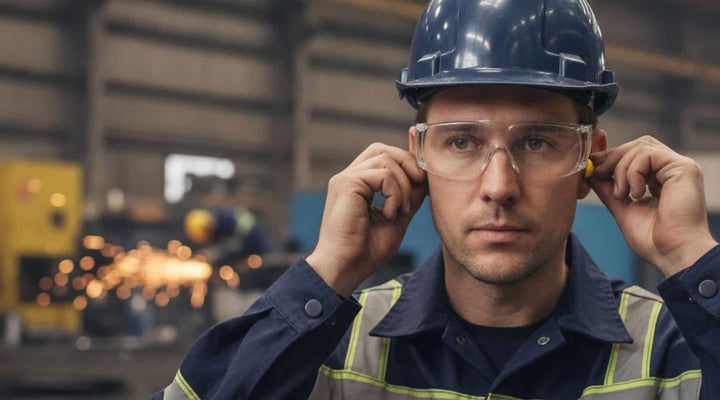
Quality personal protective equipment proves itself twice: first on the label, where materials, certifications, and documentation confirm it meets a named standard, and again in the field, where it holds up to a real hazard. This guide walks distributors through both halves. Part one shows you how to verify genuine quality. Part two shows you how to sell it to industrial buyers.
I have spent more than 30 years watching this business change. I joined the family company in 1992, and today Caco Abbo Group holds the exclusive General Electric (GE) PPE license across the Americas and the Caribbean, was the first to license WD-40 microfiber towels, and moves product into more than 38 countries. The pattern I keep seeing is simple. Distributors who can prove quality win the accounts that matter. Those who cannot compete on price until the margin disappears.
Part 1: How to Identify Genuine Quality Safety Gear
Start with materials and construction
Quality shows up before any certificate does. Pick up the glove, the vest, or the hard hat and look at how it is made. Cut-resistant gloves should feel consistent across the palm, with no thin spots at the seams where a blade would find skin. Hi-vis fabric should hold its color and reflectivity through repeated washing, not fade after a week on a jobsite. Shell plastics on head protection should carry a molded date of manufacture, because the material degrades with UV exposure and buyers replace on a schedule.
None of this requires lab equipment. It requires handling the product the way a safety manager will. I tell my team to abuse a sample before it ever reaches a client. Stretch the seams, flex the shell, and check the stitching. Gear that fails in your hands will fail in theirs, and a distributor who ships it once rarely gets a second order.
Read the certifications, then match them to the task
A certification only matters when it fits the hazard. The hand protection standard ANSI/ISEA 105 grades cut resistance from A1 through A9, where A1 to A3 handle scrapes and A4 to A6 cover cuts serious enough to need stitches. Impact protection follows a separate standard, ANSI/ISEA 138-2019, which rates the back of the hand from level 1 to 3. High-visibility apparel answers to ANSI/ISEA 107-2020. Head protection follows ANSI/ISEA Z89.1, and eye protection follows Z87.1.
Knowing the numbers is half the job. The other half is refusing to accept a bare claim. A glove marked "cut resistant" with no A-level means nothing. A vest that says "ANSI Class 2" without the label details the standard requires is a liability wearing a costume.
Verify the label, do not trust it
Here is where most low-cost gear falls apart. The International Safety Equipment Association warns that a garment can advertise "ANSI Class 2" while carrying a label that lacks the details ANSI/ISEA 107-2020 requires, which makes the product non-compliant even though it looks the part. The claim is printed. The compliance is not there.

So treat the label as a claim to be tested, not a fact to be accepted. A genuine hi-vis label names the standard, the class, and the garment type. Genuine cut-resistant gloves carry the pentagon pictogram with the A-level printed inside it. When the marking is vague, generic, or missing the standard number, the product is telling you it will not survive an audit.
Ask for the paperwork
Verification finishes with documentation. Manufacturers obtain their own testing, either in-house or through a third-party lab, to prove a product meets its standard, and the ISEA guidance is direct: any reputable seller should be happy to provide that testing paperwork on request. That single sentence is your buying filter.
Before you stock a line, ask the supplier for the test report or declaration of conformity that backs the claim on the label. A supplier who sends it within a day is worth carrying. One who stalls, deflects, or offers a marketing sheet instead of a test result is telling you what an OSHA inspector will eventually discover. Keep those documents on file, because your industrial clients will ask you for them next.
| Quality Signal | What to Check | How to Verify It |
|---|---|---|
| Materials & Build | Even cut protection, colorfast high-visibility fabric, and molded manufacturing date on hard hats or shells. | Inspect a sample by flexing seams, checking stitching quality, and confirming the molded date stamp. |
| Cut & Impact Rating | ANSI/ISEA 105 cut resistance (A1–A9) and ANSI/ISEA 138 impact protection (Level 1–3). | Locate the A-level inside the ANSI cut-resistance pictogram and verify the printed impact rating. |
| High-Visibility Compliance | ANSI/ISEA 107-2020 certification with the correct performance class and garment type. | Ensure the garment label lists the standard, class, and type—not just a generic "Class 2" claim. |
| Head & Eye Protection | Products marked with ANSI/ISEA Z89.1 for head protection and ANSI/ISEA Z87.1 for eye protection. | Check that the certification markings are molded or printed directly on the product. |
| Test Documentation | A valid test report or Declaration of Conformity supporting every certification claim. | Request documentation from the supplier before purchasing or stocking the PPE. |
Part 2: How to Market That Quality to Industrial Buyers
Sell compliance, because that is what they are buying
Once you can prove quality, position on it. Industrial buyers are not shopping for gloves. They are shopping for a clean audit and a defensible paper trail. The regulatory pressure is real: OSHA's PPE fit rule for construction, 29 CFR 1926.95, took effect on January 13, 2025, and now requires equipment that properly fits each worker. Fit, ratings, and labeling have moved from nice-to-have to citable.
That reframes your pitch. Instead of quoting a case price, lead with the standard the product meets and the documentation you keep on file. When Caco Abbo Group secured the GE license, the distributor conversations that closed fastest were the ones where we opened with compliance, not cost. Buyers relax when they hear you speak their language, because it means they can stop policing your catalog.
Put samples in their hands
Nothing shortens a sales cycle like a sample program. A safety manager who feels the palm of a cut-resistant glove and reads the A-level for themselves trusts the product more than any spec sheet can earn. Send a small, curated kit that matches their actual hazards, not a random assortment. For a metal-fabrication account, that means A6-plus gloves and impact-rated backs. For a roadwork crew, it means genuinely compliant hi-vis.
I have closed large accounts on the strength of one honest sample. The buyer stresses the product the same way I taught my team to, it holds, and the relationship starts on proof rather than promise. Ship samples that you would stake your name on, because you are.
Bundle by job, not by SKU
Industrial buyers think in tasks, not in product lines. A distributor who can assemble a complete outfit for a specific job removes friction and raises the order value at the same time. Bundle the head, eye, hand, and hi-vis protection a welding station needs, or the full kit for a night roadwork crew, and price it as a solution. This is where a broad, well-organized catalog earns its keep. Point buyers to a curated set rather than making them build a cart from scratch. The easier you make compliance, the larger and stickier the account becomes.
"Buyers stopped treating safety gear as interchangeable years ago. The distributor who can show a rating, name the standard, and produce the test report on request is the one who keeps the account. Everyone else is renting the business until someone underprices them."
Joel Abbo, CEO, Caco Abbo Group
Let a brand carry the trust
The reason quality sells at all is that buyers have grown cautious. When 5,070 workers died on the job in 2024, down from 5,283 in 2023 per the Bureau of Labor Statistics, safety managers stopped treating equipment as a commodity. They want a documented chain of quality behind every SKU, and a recognized brand shortens that verification for them.

This is why a licensed line like GE PPE does work in a sales conversation that a generic product cannot. The buyer recognizes the name, associates it with a standard, and inherits confidence they would otherwise have to build from scratch. Your job as the distributor is to pair that brand recognition with the ratings and the paperwork. Do all three, and you stop being a vendor who gets re-bid every quarter. You become the partner the safety manager calls first.
Close by making the safe choice the easy one
The final move in the sales conversation is removing risk from the buyer's decision. Keep test documentation on hand so you can answer an audit question in one call. Label your catalog by rating so a purchasing team can self-select with confidence. Offer size-inclusive ranges so a mixed crew stays compliant under the fit rule. When you make the compliant choice also the convenient choice, price stops being the deciding factor.
Frequently Asked Questions
How can a distributor tell if safety gear is genuinely high quality?
Check three things in order: materials and construction by handling a sample, the certification marking that matches the hazard, and the documentation behind the claim. Cut gloves should show an ANSI/ISEA 105 A-level in the pentagon pictogram, hi-vis should name ANSI/ISEA 107-2020 with its class and type, and the supplier should provide a test report on request. A missing or vague label, or a supplier who cannot produce paperwork, signals a product that will fail an audit.
Why is a printed "ANSI Class 2" claim not enough on hi-vis apparel?
Because a label can advertise a class without carrying the details ANSI/ISEA 107-2020 actually requires, which makes the garment non-compliant even though it reads correctly at a glance. The International Safety Equipment Association flags this directly. If the garment is worn during an incident and turns out to be non-compliant, the liability lands on the employer, so verified labeling protects both the worker and the account.
What is the best way to market quality safety gear to industrial buyers?
Lead with compliance rather than price. Industrial buyers are buying a clean audit and a defensible record, so open with the standard a product meets and the documentation you keep on file. Reinforce that with a curated sample program, job-based bundles, and recognized brands that shorten the buyer's own verification. Make the compliant choice the convenient one, and price stops driving the decision.
How does the 2025 OSHA fit rule change what distributors should stock?
OSHA's construction PPE rule, 29 CFR 1926.95, took effect on January 13, 2025, and requires equipment that properly fits each worker. A single size per line no longer covers a mixed crew, so stock size-inclusive ranges, including women's-fit gloves and vests. Distributors who carry the full range become the easy compliant choice, while those who do not send their customers looking for a second supplier.
Stock and Sell the Quality Buyers Can Verify
The distributors who grow carry gear that proves itself on the label and in the field, then market that proof to buyers who audit. Caco America supplies exactly that range, from GE PPE and hand protection to hi-vis and hand tools, backed by the documentation industrial accounts require. Browse the full catalog or apply to become a distributor at cacoamerica.com, and start selling on proof instead of price.