


PPE reference guide
PPE Materials Guide What our PPE is made of, and why
Nitrile, latex, PU, HPPE, aramid, leather, HDPE, ABS, Koroyd®, polycarbonate and more: how each material performs, where it falls short, and which products use it.
Key takeaways
- The coating sets the grip. Nitrile for oil and general work, latex for wet grip, PU for dry precision. The liner underneath sets cut resistance and comfort.
- Cut resistance comes from the yarn. Our knit cut gloves use HPPE blended with glass, steel or basalt. Adding those yarns takes them from ANSI A3 to A6; our A7 glove is a reinforced leather driver.
- Higher gauge, thinner glove. Gauge counts needles per inch on the knitting machine. Our liners run from 10-gauge cotton to 21-gauge ultra-thin nylon.
- Two shells, two jobs. HDPE hard hats are light and economical. Our Koroyd® helmets pair an ABS shell with a crushable tube layer instead of EPS foam.
- Every lens is polycarbonate. All our safety glasses, goggles, eye shields and visors use polycarbonate lenses for impact strength and UV absorption.
- Foam seals best, silicone lasts. Our PU foam earplugs carry NRR 32; reusable silicone earplugs carry NRR 26 and can be washed.
Material finder
21 materials, where they are used
Filter by body area. Each card links to the products that use the material.
Nitrile (NBR)
Synthetic rubber coating. Resists oils, greases and fuels, and it is latex-free. Available in smooth, sandy, foam and micro-foam finishes.
Natural rubber latex
Very elastic coating with strong grip on wet surfaces. Not for oils or solvents, and some workers are allergic to it.
In our products: GG211
Polyurethane (PU)
The thinnest, lightest palm coating. Best dexterity and touch for dry handling, small parts and assembly.
HPPE
High-performance polyethylene fiber. High cut resistance for its weight, and cool to the touch. The base of all our knit cut gloves.
Glass, steel and basalt yarns
Fine glass fiber, stainless steel wire or basalt wrapped with HPPE. They dull the blade and raise the cut level.
Aramid (Kevlar®)
Heat and cut resistant fiber. Kevlar® is DuPont's brand of para-aramid. In our line it is the sewing thread on welding and driver gloves.
Nylon and polyester knit
The knitted shell under the coating. The gauge sets how thin it is, from 10-gauge cotton to 21-gauge ultra-thin nylon.
Leather: grain, split, goatskin
Grain is the smooth outer hide, split the rougher inner layer. Goatskin is soft and tough for its thickness.
TPR (thermoplastic rubber)
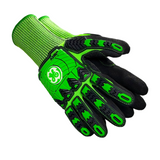
Molded rubber guards on the back of the hand that spread knuckle and finger impacts. Rated under ANSI/ISEA 138. The GG242, GG244, GG422 and GG421 use the patented Flying Eagle TPR design, with pads split at the finger joints for mobility.
HDPE
High-density polyethylene. A light, tough shell for classic hard hats, and our Class E dielectric hats.
ABS
Acrylonitrile butadiene styrene. A rigid plastic for helmet shells, earmuff cups, brims and visor carriers.
Koroyd®
Thousands of welded co-polymer tubes that crush in a controlled way to absorb impact energy, with air flowing through them.
Polycarbonate
The lens material of every pair of safety glasses we sell. High impact strength and built-in UV absorption.
In our products: 03 Series, 09 Series, GE149CAF, GH600, GH605, GH609
TPR, TPE and PVC
Soft plastics for nose pads, temple tips and goggle frames. They add grip and seal without metal parts.
In our products: 10 Series, 02 Series, GE146C, 05S Series
Polyurethane foam
Slow-recovery foam: roll it down and it expands to seal the ear canal. Single use, and the highest NRR we sell.
Silicone
Flanged, washable earplugs that keep their shape. Reusable, with a lower NRR than foam.
Polyester knit and mesh
Birdseye knit wicks sweat on hi-vis shirts; open mesh keeps vests cool. Holds fluorescent color well.
SMS nonwoven
Spunbond, meltblown, spunbond: three bonded layers. Breathable and liquid repellent, for dry dust and light spray.
Microporous film
A nonwoven laminated with a film full of tiny pores. Blocks liquids and fine particles but lets vapor out.
Rip-stop polyester
Woven with a reinforcing grid so tears do not spread. Used on our UPF 40+ reflective neck protector.
In our products: GH623
EVA foam and gel
EVA foam is light and cushions; gel cores spread pressure on hard floors. Hard PVC caps let you pivot; soft TPE caps grip. Both add puncture protection.
Gloves · coatings
Nitrile, latex and PU compared
The palm coating decides grip, dexterity and what liquids the glove can handle. These are the EN 388 results printed on our gloves; choose a property to rank them.
| Glove | Coating | EN 388 | Abrasion 0–4 | Tear 0–4 | Puncture 0–4 | ISO cut A–F | Chart |
|---|---|---|---|---|---|---|---|
 GG206Nylon, 18-gauge | PU | 2121X | 2 | 2 | 1 | X | |
 GG205Nylon, 15-gauge | PU | 3121X | 3 | 2 | 1 | X | |
 GG215Polyester, 13-gauge | Smooth nitrile | 3121X | 3 | 2 | 1 | X | |
 GG209Polyester, 10-gauge | Crinkle rubber | 2142X | 2 | 4 | 2 | X | |
 GG211Nylon, 15-gauge | Sandy latex | 3131X | 3 | 3 | 1 | X | |
 GG230Recycled polyester, 15-gauge | Micro foam nitrile | 3131X | 3 | 3 | 1 | X | |
 GG235Cotton, 10-gauge | Nitrile, fully dipped | 4121X | 4 | 2 | 1 | X | |
 GG222Polyester + spandex, 15-gauge | Foam nitrile | 4131X | 4 | 3 | 1 | X | |
 GG217Nylon + spandex, 15-gauge | Micro foam nitrile | 4131X | 4 | 3 | 1 | X | |
 GG216Nylon + spandex, 15-gauge | Micro foam nitrile | 4131X | 4 | 3 | 1 | X | |
 GG302— | Goatskin leather | 3122X | 3 | 2 | 2 | X | |
 GG345LLined | Goatskin leather | 2122X | 2 | 2 | 2 | X | |
 GG340Lined | Cowhide + split | 3123X | 3 | 2 | 3 | X | |
 GG207HPPE blend | PU | 4X42C | 4 | 4 | 2 | C | |
 GG221HPPE blend | Sandy nitrile | 4X42C | 4 | 4 | 2 | C | |
 GG223HPPE blend | Micro foam nitrile | 4X43C | 4 | 4 | 3 | C | |
 GG208HPPE + glass + steel | PU | 4X43D | 4 | 4 | 3 | D | |
 GG224HPPE + steel | Micro foam nitrile | 4X42D | 4 | 4 | 2 | D | |
 GG242HPPE + glass + steel | Micro foam nitrile | 4X42D | 4 | 4 | 2 | D | |
 GG244HPPE + basalt + steel | Foam nitrile | 4X42E | 4 | 4 | 2 | E | |
 GG201HPPE + steel + basalt | PU | 4X42F | 4 | 4 | 2 | F | |
 GG226HPPE + steel + basalt | Foam nitrile | 4X42F | 4 | 4 | 2 | F | |
 GG421Goatskin + cowhide | Leather | 4544F | 4 | 4 | 4 | F |
Levels from each glove's EN 388 code. X means not tested. EN 388 compares mechanical strength, not grip or chemical resistance.
Which coating for which job
| Smooth nitrile | Oily parts that need wiping clean. | GG215 |
|---|---|---|
| Sandy nitrile | Grip on wet and oily parts; textured finish. | GG221 |
| Foam and micro-foam nitrile | Breathable all-day wear with grip in light oil. | GG217 |
| Polyurethane (PU) | Dry precision work, small parts, electronics, touch screens. | GG205 |
| Sandy latex | Wet, slippery handling: concrete, bricks, outdoor work. Not for oils. | GG211 |
| Crinkle rubber | Draining liquids from the palm: glass, masonry, wet materials. | GG209 |
Gloves · liners and cut fibers
HPPE, aramid and the yarns that stop a blade
HPPE (high-performance polyethylene) is a very long-chain polyethylene fiber with a high strength-to-weight ratio. It resists cutting, stays cool on the hand and launders well, which is why it is the base yarn in all our knit cut-resistant gloves.
To climb the cut scale, HPPE is spun around a core of glass fiber, stainless steel wire or basalt. These hard fibers dull the blade. More of them means a higher ANSI level, a little more stiffness and, with steel, a glove that is no longer metal-free.
Aramid is a heat- and cut-resistant fiber; Kevlar® is DuPont's brand of para-aramid. It chars instead of melting, so we use aramid thread to sew our MIG and TIG welding gloves and our A7 leather driver. We do not sell knitted aramid gloves today.
ANSI/ISEA 105 cut level by liner
From our spec sheets. The A7 glove is reinforced leather, not a knit.
Knit gauge: from cushioned to ultra-thin
General-purpose glovesGauge counts the needles per inch on the knitting machine. Stitch drawings are schematic.
-
 GG235Fully Dipped Nitrile Work Gloves10-gauge
-
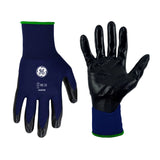 GG215Smooth Nitrile Dipped Work Gloves13-gauge
-
 GG205PU Dipped Work Gloves 15-Gauge Nylon15-gauge
-
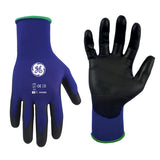 GG206Touch Screen PU Dipped Work Gloves18-gauge
-
 GG271Sandy Nitrile Touch Screen Work Gloves21-gauge


Disposable nitrile: thickness in mil
Disposable gloves are measured in mil: one thousandth of an inch, or 0.0254 mm. Thicker gloves last longer and resist tears and chemicals better; thinner gloves give more touch. All four of ours are latex-free, powder-free and rated EN ISO 374-1 Type B.
Gloves · leather and impact
Leather grades and TPR impact guards
Leather handles heat, sparks and rough materials better than coated knits. The grade depends on which layer of the hide is used.
| Cow grain | The smooth outer layer of the hide. More water-resistant than split, supple and durable. | GG309 |
|---|---|---|
| Cow split | The inner layer, split from the grain. Rougher, with good abrasion and heat resistance; economical. | GG308 |
| Goatskin | Natural lanolin keeps it soft. Tough for its thickness, so it suits dexterity work and TIG welding. | GG302 |
| Cowhide + split (welding) | Thick lined leather with aramid thread for MIG and stick welding. | GG340 |
TPR: thermoplastic rubber
TPR is a rubber that can be molded like plastic. On impact gloves it forms segmented guards over the knuckles and fingers that flex with the hand and spread a blow over a wider area. ANSI/ISEA 138 measures how much force still gets through.


Head protection
HDPE, ABS and Koroyd®
Classic hard hats rely on a hard shell and a suspension that keeps an air gap above the head. Our performance helmets add an energy-absorbing layer between the two.
HDPE (high-density polyethylene) is light, tough and resists many chemicals. It makes economical, dielectric hard hats such as the GH327 and GH329, proof-tested to 20,000 V.
ABS is a stiffer plastic with a smooth finish that holds accessory clips well. It forms the shell of our Koroyd® helmets and our earmuff cups and brims.
Koroyd® is a layer of thousands of thin co-polymer tubes welded together. On impact the tubes crush in a controlled way and absorb energy; between impacts, air flows straight through them.
| Spec sheet | HDPE hard hats (GH326–GH329) | Koroyd® helmets (GH400–GH501) |
|---|---|---|
| Shell | 100% HDPE | ABS |
| Impact layer | None (suspension only) | Koroyd® welded tubes |
| ANSI Z89.1 type | Type 1 | Type 1 (GH400, GH401) or Type 2 (GH500, GH501) |
| Electrical class | C (vented) or E · G | C (vented) or E · G (GH401, GH501) |
| Suspension | 4-point ratchet, nylon | Ratchet system |
| Chin strap | Included on the full brim GH329 | 4-point adjustable (GH501); EN 12492 anchor (GH400) |
-
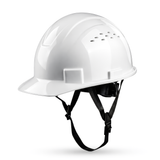 GH326Vented Cap Style Hard HatType 1 · Class C
-
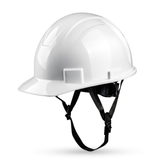 GH327Cap Style Hard HatType 1 · Class E
-
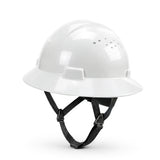 GH328Vented Full Brim Hard HatType 1 · Class C
-
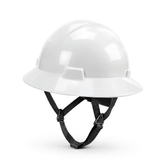 GH329Full Brim Hard HatType 1 · Class E
-
 GH400Vented Type 1 Safety Helmet with KoroydType 1 · Class C
-
 GH401Non-Vented Type 1 Safety Helmet with KoroydType 1 · Class E
-
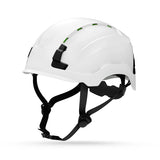 GH500Vented Type 2 Safety Helmet with KoroydType 2 · Class C
-
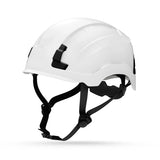 GH501Non-Vented Type 2 Safety Helmet with KoroydType 2 · Class E


Eye protection
Polycarbonate lenses and frame materials
Every lens we sell is polycarbonate: a clear thermoplastic with far higher impact strength than glass or acrylic, and it absorbs UV by itself. Our spec sheets list 99.9% UV protection on models such as the 06 Series. Polycarbonate scratches easily on its own, so most of our lenses add an anti-scratch hard coat, and many add anti-fog.
Impact-resistant does not mean unbreakable. Replace any lens that is cracked, pitted or deeply scratched.
Base curve
The base curve is how much the lens bends. Flat lenses (base 2.5 on the 12 OTG) fit over prescription glasses; high curves (base 9.5 to 10) wrap the face and close gaps at the sides.
| Part | Material | Where |
|---|---|---|
| Lenses | Polycarbonate | Every model |
| Frames | Nylon or polycarbonate | 01, 04, 10 nylon; 06, 08, 09 polycarbonate |
| Nose pads | TPR, TPE or soft PVC | Adjustable on 02, 05, 06, 08, 09; molded on 01, 03, 14, 15 |
| Goggle body | PVC, or PP + TPE seal | GE146C, GE147C, GE148CAF PVC; GE149CAF soft TPE seal |
| Hinges | Stainless steel or polycarbonate snap-in | Snap-in, metal-free on 02, 11S, 15 |
| Gasket | EVA foam | Spoggles 05S and 11S |
Hearing protection
Foam, silicone and ABS earmuffs
Slow-recovery PU foam expands to fill the ear canal, which is why it carries our highest NRR. Silicone flanges seal less tightly but can be washed and reused. Earmuffs pair rigid ABS cups with soft PU foam cushions. The earplugs and the GM450 and GM453 earmuffs are metal-free.
| Material | NRR | SNR | Use | Products |
|---|---|---|---|---|
| PU foam earplugs | 32 dB | 38 dB | Single use | GP420, GP425, GP426, GP427, GP444 |
| Silicone earplugs | 26 dB | 32 dB | Reusable, washable | GP439, GP440, GP445 |
| Earmuffs: ABS cups, PU foam cushions | 23–27 dB | 26–31 dB | Reusable | GM450, GM451, GM452, GM452HV, GM453, GM454 |
NRR and SNR from each product's spec sheet.
Body and hi-vis
Polyester, SMS and microporous fabrics
Fabric weight is given in GSM, grams per square meter. Higher GSM is usually stronger and more opaque; lower GSM is lighter and cooler.
SMS stacks two spunbond layers for strength around a meltblown core of very fine fibers that filters particles. It breathes well and repels light splashes.
Microporous fabric laminates a nonwoven to a film with pores small enough to stop liquid droplets and fine dust while letting water vapor escape. It is the better barrier, and the GW902 and GW904 also pass EN 14126 for infectious agents.
| Fabric | Used in | Why | Products |
|---|---|---|---|
| Polyester birdseye knit | Hi-vis shirts | Moisture wicking, UPF 40+, mesh side panels | GS112, GS114, GS116, GS118 |
| Polyester mesh, 105–120 GSM | Hi-vis vests | Open weave for airflow; solid front panels on surveyor vests carry pockets | GV076, GV078, GV082, GV084, GV086, GV088 |
| SMS nonwoven, 50 GSM | Coveralls | Breathable, liquid repellent; Type 5/6 | GW900, GW901 |
| Microporous laminate, 63 GSM | Coveralls | Higher barrier to liquids and fine particles; Type 5/6, some with EN 14126 | GW902, GW903, GW904 |
| Rip-stop polyester | Neck protector | Tear-stop grid, UPF 40+, reflective edge | GH623 |
Knee protection
EVA foam, gel cores and caps
EVA (ethylene-vinyl acetate) foam is light and springy. A gel core spreads pressure on hard floors, and a hard cap lets you pivot and keeps debris out. A soft TPE cap grips smooth floors without marking them.
| Model | Padding | Cap | Closure | Best for |
|---|---|---|---|---|
| GR550 | Medium-density EVA foam | None (soft cover) | Hook-and-loop straps | Indoors, flooring, tight spaces |
| GR551 | EVA foam with gel core | Thick PVC cap | Quick-release slide clip | Indoors and outdoors, rough surfaces |
| GR553 | Contoured EVA and gel foam | TPE grip cap | Adjustable neoprene straps | Concrete, landscaping, all-day kneeling |


Reference
Glossary
The terms used on this page and on our product spec sheets.
- Nitrile (NBR)
- Nitrile butadiene rubber. A synthetic rubber that resists oils and fuels and contains no natural latex proteins.
- Natural rubber latex
- Rubber made from the sap of the rubber tree. Very elastic, with strong wet grip; a known allergen.
- Polyurethane (PU)
- A polymer used as a very thin, flexible palm coating for dry, precise work.
- Foam / micro-foam
- Coatings with air cells that breathe and pull light oil away from the grip surface.
- Sandy finish
- A textured coating made by adding salt or sand during dipping, for grip on wet or oily parts.
- HPPE
- High-performance polyethylene, usually made from UHMWPE. A strong, light fiber with high cut resistance.
- Aramid
- A family of heat- and cut-resistant synthetic fibers. Para-aramid is sold as Kevlar® (DuPont) and Twaron® (Teijin).
- Basalt fiber
- Fiber spun from volcanic rock, blended into cut-resistant yarns.
- Gauge
- The number of needles per inch on the knitting machine. Higher gauge means a thinner, more dexterous liner.
- Mil
- A thousandth of an inch (0.0254 mm), used for disposable glove thickness.
- GSM
- Grams per square meter, the weight of a fabric.
- TPR
- Thermoplastic rubber. Molded into impact guards on the back of gloves and soft nose pads.
- TPE
- Thermoplastic elastomer. Soft-touch plastic for temple tips, goggle seals and knee pad caps.
- HDPE
- High-density polyethylene. Light, tough plastic used for hard hat shells.
- ABS
- Acrylonitrile butadiene styrene. A rigid plastic used for helmet shells, earmuff cups and brims.
- Koroyd®
- An energy-absorbing core of welded co-polymer tubes, used in place of EPS foam.
- EPS
- Expanded polystyrene foam, the usual liner in sports and climbing helmets.
- Polycarbonate
- An impact-resistant, UV-absorbing clear plastic used for safety lenses and visors.
- Base curve
- How much a lens bends. Higher numbers wrap closer to the face.
- SMS
- Spunbond-meltblown-spunbond nonwoven fabric: strength outside, fine filtration inside.
- Microporous film
- A film with pores that let water vapor through but stop liquids and fine particles.
- EVA foam
- Ethylene-vinyl acetate foam. Light, cushioning padding used in knee pads.
- Grain / split leather
- Grain is the outer layer of the hide; split is the inner layer left after the grain is removed.
Frequently asked questions
Short answers on coatings, fibers, shells and fabrics.
Nitrile, latex or PU: which glove coating is best?
It depends on what you handle. Nitrile is the all-rounder and the choice for oily parts. Latex gives the best grip on wet, rough surfaces but not with oils. PU is the thinnest and gives the most dexterity for dry work. Compare our general-purpose gloves by coating above.
Is HPPE the same as Kevlar?
No. HPPE is a polyethylene fiber; Kevlar® is DuPont's brand of para-aramid. Both resist cuts. HPPE is lighter and cooler on the hand, while aramid handles heat better. Our cut gloves use HPPE blends; we use aramid as thread in welding gloves.
What does glove gauge mean?
Gauge is the number of needles per inch on the knitting machine. A 10-gauge liner is thick and cushioned; a 21-gauge liner is thin enough to use a touch screen. Our liners range from 10 to 21 gauge.
What is Koroyd and why is it in a safety helmet?
Should I choose an HDPE or an ABS hard hat?
Either shell can meet ANSI/ISEA Z89.1; check the helmet’s certification. HDPE hard hats are the economical choice. Our ABS helmets add a Koroyd® impact layer, Type 2 options and accessory mounts for visors, eye shields and earmuffs.
Are polycarbonate safety lenses shatterproof?
They are highly impact-resistant, not unbreakable. Polycarbonate is the standard material for ANSI Z87.1 lenses because it resists impact far better than glass. Replace lenses that are cracked or deeply scratched.
SMS or microporous coverall: which do I need?
Foam or silicone earplugs?
Foam earplugs seal better: ours are rated NRR 32 against NRR 26 for silicone. Silicone earplugs are washable and reusable, which suits workers who move in and out of noise all day.
Keep reading
Standards applied by industry, and the materials behind the ratings.
- Safety StandardsANSI, ISEA, EN and OSHA ratings explained
- ConstructionHard hats, impact gloves and hi-vis for job sites
- Oil & GasClass E helmets, oil-grip gloves and coveralls
- ManufacturingCut-resistant gloves by ANSI level and ergonomics
- MiningType 2 helmets, impact gloves and hearing protection
- Electrical & UtilitiesClass E dielectric head, eye and hearing protection
- Transportation & LogisticsHi-vis vests, driver gloves and back support
- Warehousing & DistributionPicking gloves, back support and forklift-zone hi-vis
- Agriculture & FarmingWaterproof gloves, coveralls and UPF sun protection
Sources
- Caco America product spec sheets Materials, EN 388 codes, cut and impact levels, NRR and GSM for each product, Nov 2026.
- EN 388:2016+A1:2018 Mechanical test levels.
- ANSI/ISEA 105-2016, 138-2019 Cut and impact classification.
- EN ISO 374-1:2016 Chemical permeation classification.
- Koroyd® technical information Tube structure and energy absorption (manufacturer data).
- OSHA 3151, Personal Protective Equipment General glove material selection.
Not sure which material fits the job?
Send us the task, the surfaces and any chemicals. We will recommend the glove, helmet or garment and quote by the case.