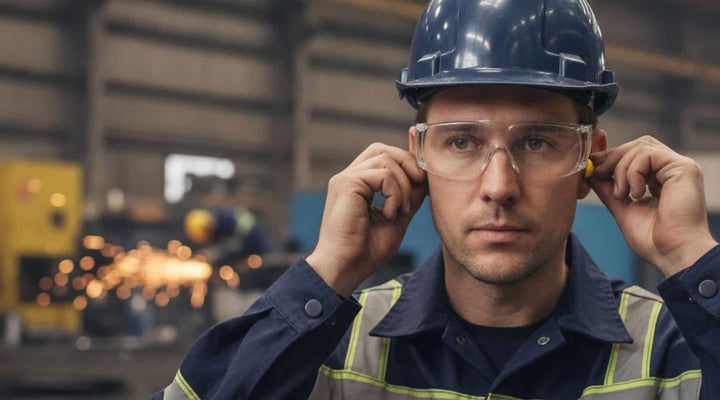
To navigate the safety gear market, a distributor should evaluate personal protective equipment against the standard that governs each category, not on unit price alone. Check gloves for ANSI/ISEA cut and impact ratings, head and eye gear for ANSI Z-series compliance, hearing protection for a labeled NRR, and hi-vis apparel for ANSI/ISEA 107 class marking before carrying it.
That last sentence is the whole job. A safety equipment supplier lives or dies on what it chooses to stock, and the choosing has gotten harder. Buyers who once ordered by catalog number now ask which cut level a glove hits and whether a vest will survive an audit. I have watched that shift firsthand. When Caco Abbo Group secured the exclusive General Electric (GE) PPE license across the Americas and the Caribbean, most distributor calls opened with price per case. The first question is usually about ratings, sizing, and paperwork now. This guide walks the five PPE categories a distributor stocks most, and the features to check before you commit shelf space.
How to evaluate a category before you carry it
Every strong stocking decision runs through the same four filters. First, the governing standard: which OSHA regulation or ANSI/ISEA standard applies, and does the label prove compliance? Second, the rating or class: a real number a buyer can spec against, not a marketing phrase. Third, sizing range, because one SKU rarely covers a mixed crew and OSHA now treats poor fit as a hazard. Fourth, documentation you can produce when a safety manager asks.
Run those four filters and the weak product falls out fast. A glove with no cut level, a vest with an unverifiable class claim, or a helmet missing its ANSI marking should never reach your catalog. The checklists below apply this method category by category. Browse the full CACO catalog at cacoamerica.com to see how a rated, category-organized inventory looks in practice.
Hand protection: buy by rating, never by feel
Hand protection is where buyers have gotten the most technical, so your sourcing has to be sharpest here. OSHA 29 CFR 1910.138 requires employers to select hand protection matched to the specific hazard, which means your customers need options rated for the job, not a single all-purpose glove. Two ANSI/ISEA standards carry the load. ANSI/ISEA 105 grades cut resistance from A1 through A9, based on the grams of load needed to cut through the material. ANSI/ISEA 138 grades back-of-hand impact protection from level 1 to level 3.
Carry the full cut range, because a buyer handling cardboard needs an A2 while a buyer handling sheet metal needs an A5 or higher. Stock impact-rated gloves for oil, gas, and demolition accounts, and label every SKU with its rating so buyers self-select. Carrying a cut-resistant line against an impact-resistant line shows why one catalog line per hazard is not enough.
The cut scale is worth understanding at a glance, because it directly drives which SKUs you carry for which accounts.

Head protection: confirm type and class, not just color
Head protection looks interchangeable until an incident review asks whether the helmet met the standard. ANSI/ISEA Z89.1 is the reference, and it splits head protection two ways. Type I guards against top impact only. Type II adds lateral impact protection, which matters where hazards come from the side, not just overhead. Electrical class layers on top: Class G handles up to 2,200 volts, Class E up to 20,000 volts, and Class C offers no electrical protection but better ventilation.
So a utility or electrical account needs Class E, while a general construction crew may run Class G. Type II is the growth area as safety managers move toward higher-protection helmets. Confirm the ANSI marking is molded into the shell, not printed on a hang tag that walks away. Carry a head protection range that spans both types and the common classes, and you cover accounts a single-SKU competitor cannot.
Eye protection: the label has to say Z87
Eye and face protection is where cheap imports fail most often, and the failure is easy to spot if you know where to look. OSHA 29 CFR 1910.133 governs eye and face protection and points to ANSI Z87.1 as the benchmark. The tell is simple: compliant eyewear carries a Z87 or Z87+ mark on the lens and frame, and the plus sign signals a high-impact rating. No mark, no sale, because a safety manager cannot document unmarked eyewear as compliant.
When you evaluate an eyewear line, put on a pair and check the marking yourself. Look for anti-fog and UV coatings for outdoor accounts, and confirm the frame carries the same Z87 stamp as the lens. Stocking protective eyewear a buyer can verify at a glance removes the biggest liability in the category, which is a worker wearing glasses never rated for the hazard in front of them.

Hearing protection: an NRR on every package
Hearing protection is deceptively simple, and that is exactly why buyers get burned. OSHA 29 CFR 1910.95 sets a permissible exposure limit of 90 dBA over an 8-hour time-weighted average and an action level of 85 dBA that triggers a hearing conservation program. To meet those thresholds, a buyer has to know how much a plug or muff attenuates, and that number is the Noise Reduction Rating printed on the package.
The stocking rule is short. Every earplug and earmuff you carry must show a clear NRR on its packaging, because a buyer sizing protection for an 85 dBA-plus environment cannot spec without it. Carry foam plugs for high-attenuation needs and banded or over-ear muffs for intermittent-exposure accounts. A hearing protection line with a visible NRR on every SKU lets a safety manager match the product to the measured noise level on their floor.
High-visibility apparel: class marking is the whole ballgame
Hi-vis is where the compliance gap is widest and the online-grade product is most tempting. ANSI/ISEA 107-2020 is the standard for high-visibility safety apparel, and it classifies garments two ways. Types cover the use case: Type O for off-road, Type R for roadway, and Type P for public safety. Performance Classes 1, 2, and 3 cover how much reflective and background material the garment carries, with Class 3 the highest visibility.
Plenty of low-cost hi-vis claims a class it cannot back up, and that gap becomes your customer's liability the moment an incident happens. When you evaluate a hi-vis line, confirm the label states the type, the class, and the standard, then keep the compliance documentation on file. Stock verified hi-vis products rather than the cheapest lot. The distributor who guarantees a genuine Class 2 or Class 3 garment wins the accounts that care about audits, which is nearly all of them now.
"Anybody can buy a container of gloves. The distributors who keep the account are the ones who can look at a spec sheet and tell a safety manager exactly which cut level, which class, and which standard they are getting. That knowledge is the product. The gloves are just what shows up on the truck."
Joel Abbo, Chief Executive Officer, Caco Abbo Group
The distributor's PPE evaluation checklist
Use this matrix as a stocking gate. If a product cannot clear the governing standard and produce a rating you can label, it does not belong in your catalog.
| PPE Category | Governing Standard | Feature to Verify Before You Stock | Stocking Signal |
|---|---|---|---|
| Hand Protection | ANSI/ISEA 105 (cut) and 138 (impact); OSHA 1910.138 | Cut level A1–A9 and impact level 1–3 clearly marked on the SKU. | Carry the full cut range plus impact-rated lines; label each product clearly. |
| Head Protection | ANSI/ISEA Z89.1; OSHA 1910.135 | Type I or II and Class G, E, or C molded into the helmet shell. | Stock both helmet types and common classes; verify molded certification markings. |
| Eye & Face Protection | ANSI Z87.1; OSHA 1910.133 | Look for the Z87 or Z87+ mark on both the lens and frame. | Reject unmarked eyewear; stock anti-fog and UV-protective options. |
| Hearing Protection | Labeled NRR; OSHA 1910.95 | Noise Reduction Rating (NRR) printed on every package. | Carry foam earplugs and earmuffs with visible NRR labeling. |
| High-Visibility Apparel | ANSI/ISEA 107-2020 | Type (O, R, P) and Class (1, 2, 3) stated on the garment label. | Stock verified Class 2 and Class 3 garments; maintain compliance documentation. |
Why the standard matters more than the price
The market is not getting less demanding. When 5,070 workers died on the job in 2024, down 4.0 percent from 5,283 in 2023 according to the Bureau of Labor Statistics, and transportation and material-moving work still led the fatality count, safety buyers stopped treating equipment as a commodity. They want a documented chain of quality behind every SKU, and they want a supplier who can explain it.
That is the opening for a distributor who stocks well. A licensed, branded line like GE PPE carries a name that stands behind the standard, and a distributor who carries it inherits that trust. Private-label product still has a place on the shelf. But the safety manager signing a large order increasingly wants a brand, a rating, and paperwork that survives an audit. Supply all three and you stop being a vendor. You become the partner they call first.
Frequently asked questions
How does a distributor evaluate quality in the safety gear market?
Evaluate every line against four filters: the governing OSHA or ANSI/ISEA standard, a specific rating or class the buyer can spec, a sizing range that covers a mixed crew, and compliance documentation you can produce on demand. A product that cannot clear all four should not enter your catalog, no matter how low the unit price.
What ratings should distributors check on personal protective equipment?
Check cut level A1 to A9 and impact level 1 to 3 on gloves, Type and Class markings on helmets, the Z87 mark on eyewear, a printed Noise Reduction Rating on hearing protection, and the ANSI/ISEA 107 type and class on hi-vis apparel. These are the numbers a safety manager uses to defend a purchase in an audit.
Why does PPE fit matter to a safety equipment supplier's stocking plan?
OSHA amended 29 CFR 1926.95, effective January 13, 2025, to require construction PPE to properly fit each worker. A single size per line no longer covers a mixed crew, so distributors need size-inclusive ranges, including women's-fit gloves and vests, to keep construction accounts compliant without a second supplier.
Is cheaper high-visibility apparel a real compliance risk?
Yes. Many low-cost hi-vis garments claim an ANSI class without carrying the label details ANSI/ISEA 107-2020 requires. If that garment is worn during an incident, the liability lands on the employer. Verified, properly labeled hi-vis protects the worker and the account, which is why it belongs on your shelf instead of the cheapest lot.
Stock the safety gear market like a partner, not a warehouse
The distributors who grow carry PPE rated to the standard their buyers cite, sized for real crews, and backed by paperwork that holds up. Caco America supplies that range across every category in this guide, from GE PPE to hand tools, with the documentation industrial accounts require. Review the full catalog at cacoamerica.com, match each line to the checklist above, and stock the safety gear market the way your best accounts already buy it.