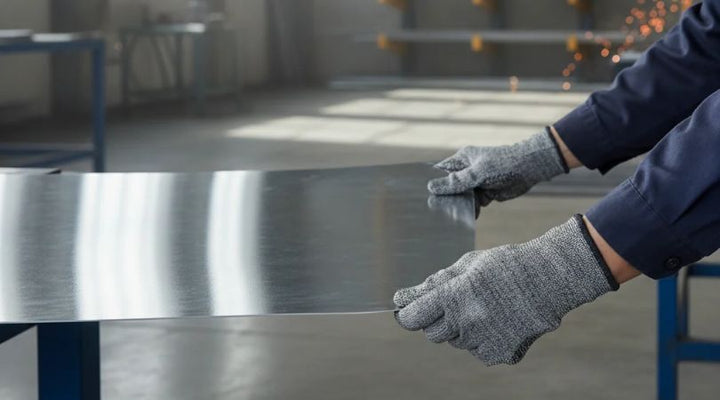
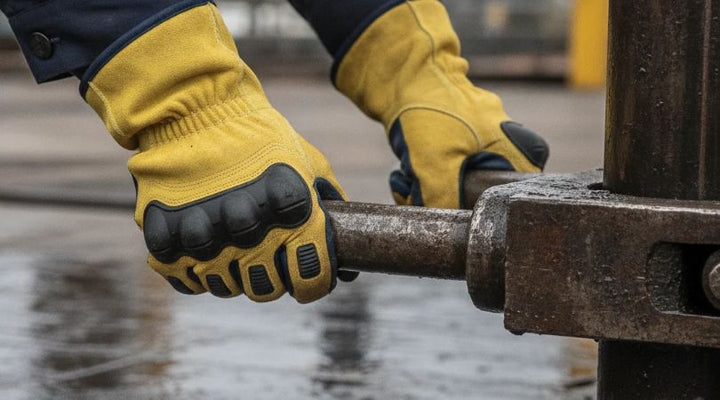
At CACO America, our answer is cut level 4 gloves (ANSI A4, 1,500 to 2,199 grams) for most work where an edge could open a cut that needs stitches. Move up to cut level 5 (A5, 2,200 to 2,999 grams) when sharp metal sits in the hand most of the shift. Drop to A3 only for scrape hazards.
I joined our family business in 1992, and in more than 30 years of selling hand protection the A3, A4, and A5 argument has never gone away. The ends of the scale are easy calls. The middle is where orders get argued. If you want the full scale and the test method first, our ANSI cut level decoder covers A1 to A9. This post stays on the middle three.
A3, A4, and A5 by the numbers
Every ANSI cut level is a band of grams, not a single score. Under ANSI/ISEA 105-2024, a lab measures how much blade force it takes to cut through the palm material, and the result lands in one of nine bands. The ANSI Blog's breakdown of the 2024 standard lists the three that matter here:
- A3:1,000 to 1,499 grams
- A4:1,500 to 2,199 grams
- A5:2,200 to 2,999 grams
Two things follow from those numbers. First, the floor of A5 sits 2.2 times higher than the floor of A3, so the jump from cut level 3 gloves to cut level 5 gloves is bigger than the labels suggest. Second, the bands are wide. A glove scoring 2,190 grams carries an A4 tag, and one scoring 2,210 grams carries A5, even though they perform almost the same.
ISEA's Key to Hand Classifications labels A3 as light to medium cut hazards, A4 as medium, and A5 as medium to heavy.

The decision table: level, grams, tasks, and our pick
ISEA groups the scale into practical bands on its hand protection guidance page: A1 to A3 protects against scrapes, and A4 to A6 protects against cuts that would need stitches. That line between A3 and A4 is the most important one in this post.
| Cut Level | Gram Range | Typical Tasks | Comfort Trade-Off | CACO Pick |
|---|---|---|---|---|
| A3 | 1,000–1,499 g | Material handling, warehousing, packaging, and general assembly | Lightest protection in this comparison; suitable for scrapes, but not sheared edges. | GG221 Hi-Vis Sandy Nitrile |
| A4 | 1,500–2,199 g | Drywall, electrical, HVAC, light glass, and appliance work | 13-gauge knit with steel in the liner; thin enough to handle small parts. | GG224 Micro Foam Nitrile or GG208 PU Dipped |
| A5 | 2,200–2,999 g | Metal fabrication and handling, including sharper sheet stock | Higher cut score; the 21-gauge knit helps maintain fingertip feel. | GG275 Touch Screen A5 |
| A6 (Step-Up) | 3,000–3,999 g | When an A5 specification needs a 13-gauge PU glove | Clears the A5 minimum; PU palm favors dry or lightly oily parts. | GG201 A6 PU Dipped |
Source: gram ranges per ANSI/ISEA 105-2024 (ANSI Blog); task examples drawn from the A1 to A3 and A4 to A6 application lists in the ISEA Key to Hand Classifications; glove specs from each live CACO product page, October 29, 2026.
Cut level 3 gloves: right for scrapes, wrong for sheet edges
A3 earns its place on the shelf. Picking, packing, and general assembly rarely put a fresh metal edge in the palm, and an A3 knit handles the scrape hazards ISEA assigns to that band.
Our pick is the GG221 High-Visibility Cut Level 3 Dipped Work Glove. Per its product page, it runs a 13 gauge liner of HPPE, polyester, nylon, glass fiber, and spandex in high-visibility green, with a black sandy nitrile palm. It adds touch screen fingertips, a reinforced thumb crotch, and a longer cuff.
The hi-vis liner is the reason I would stock it. In a yard or a loading dock, a supervisor can see from across the floor whether hands are covered.
Once a task involves a cut that would need stitches, ISEA's own banding moves you to A4. Selling an A3 for that work saves a buyer a little and costs a worker a lot.
Cut level 4 gloves: the stitches-level default
A4 is the first level in ISEA's stitches band, and for most stitches-level trades it is enough. Both featured A4 gloves share a 13 gauge liner with steel in the blend. The real difference is the coating.
GG224 micro foam nitrile
The GG224 Micro Foam Nitrile Dipped Cut Level 4 Glove pairs a liner of HPPE, polyester, steel, and spandex with a black micro foam nitrile coating, a reinforced thumb crotch, and a longer cuff. Pick it where parts arrive oily. Foam nitrile channels oil away from the grip surface, as our cut-resistant collection guide explains.
GG208 PU dipped
The GG208 PU Dipped Cut Resistant A4 Work Glove uses HPPE, glass fiber, steel wire, spandex, and polyester under a gray polyurethane palm. PU gives a thin, tactile feel and excellent dry grip, but it does not handle oil well. Choose it for clean, dry parts.

Cut level 5 gloves: when 2,200 grams is the floor
Here is the honest part. None of the four gloves featured in this guide is an A5. When a hazard assessment calls for at least 2,200 grams, you have two real routes.
Route one: the A5 we stock. Our cut-resistant collection lists one A5, the GG275 Touch Screen Cut Level 5 Dipped Work Glove. Its page lists a 21 gauge liner of HPPE, metal wire, polyester, and spandex, a black sandy nitrile coating, and touch screen fingertips. The finer 21 gauge knit is the point: it keeps fingertip feel while the cut score climbs.
Route two: step up to A6. An A6 glove clears every A5 requirement because its floor is 3,000 grams. The GG201 A6 Cut Resistant Safety Glove uses a 13 gauge liner of HPPE, steel wire, basalt, spandex, and polyester under a gray PU coating. Its page rates the grip for dry and slightly oily conditions.
My rule is simple. Crews scanning or typing on devices get the GG275. Crews handling stock all shift get the GG201.
Comfort trade-offs as the number climbs
Higher cut scores usually come from engineered yarns. Manufacturers blend steel, glass fiber, or mineral fibers into the HPPE knit, and our lineup shows it: glass fiber in the A3, steel in both A4s, steel wire plus basalt in the A6.
One surprise in the spec tables: in this lineup, climbing from A3 to A6 does not force a thicker knit. All four featured gloves run 13 gauge. The comfort difference comes mostly from the coating:
- Sandy nitrile (GG221, GG275):a textured palm that grips hard, even on wet, oily parts.
- Micro foam nitrile (GG224):grip that holds when oil is present.
- Polyurethane (GG208, GG201):a thin palm with excellent dry grip and fingertip feel.
Over-specifying still backfires. A glove that fights the fingers comes off, and a glove in a back pocket protects nobody. Pick the lowest level that covers the worst edge, then pick the coating that matches the part.
Cost per pair at today's listed prices
Prices below are the listed price on October 29, 2026, for each glove's single-pair listing on its CACO product page.
- GG208 (A4):$7.15 per pair
- GG221 (A3):$7.85 per pair
- GG224 (A4):$9.25 per pair
- GG201 (A6):$6.15 in size M (marked down from $8.15), $8.15 in L and XL
- GG275 (A5):$27.30 per pair
In this lineup, price does not track cut level. One A4 lists below the A3, and the A6 lists far below the A5. The gap follows construction, not the cut score. The priciest glove here, the GG275, is also the only one with an ultra-thin 21 gauge knit.
For volume programs, list price is only the starting point. Our distributor program quotes case pricing.
"Nobody gets hurt by the cut level printed on a spec sheet. They get hurt by the glove they pulled off at ten o'clock because it fought them. Buy the lowest level the edge demands, then buy enough of it." Joel Abbo, CEO, Caco Abbo Group
A three-question test before you order
OSHA's hand protection rule, 29 CFR 1910.138, requires employers to base glove selection on the task, the conditions, the duration of use, and the hazards identified. Three questions turn that into a cut level:
- Could the worst edge cause a cut that needs stitches?No means A3. Yes means A4 at minimum.
- Is sharp or freshly sheared metal in the hand for most of the shift?No keeps you at A4. Yes pushes the floor to A5.
- Do workers need thin fingertips and touch screen use?Yes points to the GG275. No points to the GG201 step-up.
One more check: cut ratings say nothing about the back of the hand. If pinch points or dropped tools are part of the job, look at our impact-resistant gloves as well.

Match the glove to the worst edge on the job
Start with the edge, not the catalog. Run your task list through the three questions, then compare every rated style side by side in our cut-resistant gloves collection, where you can filter by ANSI cut level, gauge, and coating. If you are still matching gloves to specific trades, our companion guide to the best cut-resistant gloves by task maps each job to a style. Distributors in our network across more than 38 countries can also lean on our team, which backs the exclusive GE PPE license across the Americas and the Caribbean.
Frequently asked questions
What is the difference between cut level 4 and cut level 5 gloves?
Cut level 4 gloves withstand 1,500 to 2,199 grams of blade force in the ANSI/ISEA 105-2024 test, while cut level 5 gloves withstand 2,200 to 2,999 grams. Both sit in ISEA's stitches band, so A4 covers most stitches-level work. A5 makes sense when sharp or freshly sheared metal stays in the hand for most of the shift.
Are cut level 3 gloves enough for construction work?
Sometimes. ISEA's Key to Hand Classifications lists construction among the applications for the A1 to A3 band, which protects against scrapes. If the job involves sheet metal, duct work, glass, or any edge that could cause a cut needing stitches, move to A4 or higher. Match the level to the sharpest thing a hand actually touches, not the trade name.
Can I use an A6 glove when the spec calls for A5?
Yes. Cut levels set a minimum, and an A6 glove's floor of 3,000 grams sits above the A5 range of 2,200 to 2,999 grams. The trade-off is fit and feel, not compliance. Trial the glove on the real task first, because a higher-rated glove only protects if workers keep it on for the whole shift.
Does CACO America sell a cut level 5 glove?
Yes. Our collection carries the GG275 Touch Screen Cut Level 5 Dipped Work Glove, rated ANSI Cut Level 5 on its product page, with a 21 gauge liner, a black sandy nitrile coating, touch screen fingertips, and sizes S to 2XL. For A5-level hazards where touch screen use is not needed, the GG201 A6 glove also clears the A5 floor.
Do higher cut level gloves always cost more?
Not in our lineup. On October 29, 2026, the A4 GG208 listed at $7.15 per pair, below the A3 GG221 at $7.85, and the A6 GG201 listed at $6.15 to $8.15 depending on size. The A5 GG275 listed at $27.30. In this lineup, construction details such as coating, hi-vis yarn, touch screen tips, and knit gauge separate prices more than the cut score does.
What does 13 gauge mean on cut level 4 gloves?
Gauge describes how fine the knit is. A higher gauge number means a finer, thinner knit with more stitches, so a 21 gauge glove feels thinner than a 13 gauge glove, and a 10 gauge glove feels heavier. For most industrial work, 13 gauge is the balance point between dexterity and durability, which is why both featured A4 gloves use it.