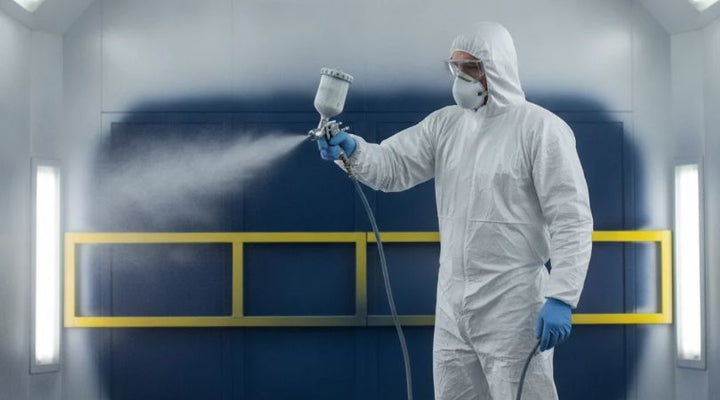
A Tyvek suit is a disposable coverall made from DuPont's flash-spun polyethylene, and most buyers now use the name for any white protective suit. Microporous coveralls use a thin film laminated to a nonwoven base, which sheds light liquid well. At CACO America, we pick between them by hazard: dust, light spray, or both.
That short answer hides the decision that matters. I have spent more than 30 years in this business, since joining our family company in 1992, and disposable suits are a category where people often order by nickname instead of by rating. Our industrial coveralls guide covers woven versus disposable garments. This one goes a layer deeper, into the fabric itself.
What buyers mean when they say "Tyvek suit"
Tyvek® is a registered DuPont trademark. DuPont describes it as sheet material made from fine, continuous high-density polyethylene (HDPE) fibers, flash-spun and then bonded with heat and pressure. Garments made from it became so common that the brand name turned into shorthand for the whole category.
So let me be plain about where we stand. CACO America does not sell Tyvek, and nothing in this guide compares our suits against a DuPont product. When a buyer asks us for "Tyvek suits," the useful translation is "a disposable coverall that keeps dust and light splash off my crew."
That request can be met by three fabric families. Each is built differently, and each trades breathability against barrier in its own way. The label that settles the order is not the brand on the bag. It is the Type rating printed on the garment.
Three disposable fabrics, three constructions
Most limited-use suits fall into a few broad fabric technologies. They look nearly identical folded in a case, which is exactly why buyers confuse them.
Flash-spun polyethylene
This is the fabric behind the nickname. Continuous HDPE fibers are spun and thermally bonded into a single sheet, with no added coating or film. The barrier comes from the sheet structure itself, which is why it handles dry particulates well.
Microporous film laminate
A microporous fabric is a bi-laminate: a thin microporous film bonded to a spunbond polypropylene base. The film faces outward and does the work of repelling liquid. The trade-off is durability. If the film abrades through on rough work, the barrier at that spot goes with it.
SMS (spunbond, meltblown, spunbond)
SMS sandwiches a meltblown polypropylene layer between two open spunbond layers. The meltblown core filters particles. Because the outer layers are open, SMS breathes easily but offers a more limited liquid barrier. It suits dirt, dust, and very light overspray.
| Fabric Type | Breathability | Particle Barrier | Splash Barrier | Typical Jobs |
|---|---|---|---|---|
| Flash-Spun Polyethylene | Breathable bonded sheet with no coating or film | Good; the barrier comes from the sheet itself | Light splash; confirm the Type 6 marking | Dusty demolition, insulation, and general dirty work |
| Microporous Film Laminate | Lower; the liquid-repelling film limits airflow | Good; GE microporous models are Type 5 rated | Film repels light liquid well; protection drops where it abrades | Spray painting, pesticide spraying, cleaning, and remediation |
| SMS | Highest; open outer layers move air freely | Good; the meltblown core filters, and GE SMS models are Type 5 rated | Limited; the open structure lets liquid through sooner | Dry sanding, warehouse dust, visitor, and hygiene use |
Type 5 and Type 6, in plain terms
Those Type numbers come from European and international chemical protective clothing standards, and they are what you should actually read on a suit.
Type 5 is defined by ISO 13982-1, which sets minimum requirements for full-body clothing resistant to penetration by airborne solid particles. It covers airborne particulates only. A Type 5 label says nothing about liquids or vapors.
Type 6 comes from EN 13034. The standard's published scope covers limited-performance suits for light spray, liquid aerosols, or low-pressure, low-volume splashes, where a complete permeation barrier is not required.
A peer-reviewed overview of these standards in Industrial Health explains the whole-suit tests. Type 5 garments are checked for inward leakage of a fine salt aerosol on test subjects. Type 6 garments face a low-pressure water spray.
Here is the line I draw for every buyer. Type 5/6 is mist-and-dust protection. Pressurized spray, jets, soaking, or chemical vapor need a higher-rated suit chosen from the chemical's data.

Breathability versus barrier: the trade you cannot skip
Every fabric choice in this category is a trade. Textile researchers tested 36 protective clothing materials and reported, in the Journal of the Textile Institute, a general negative relationship between protection and air permeability. Microporous materials showed relatively high barrier performance, with less protection against low surface tension, high viscosity liquids.
That matches what the constructions predict. A film that blocks liquid also slows airflow. An open SMS web that moves air freely lets liquid through sooner.
Heat is the cost that shows up on the crew. NIOSH notes on its PPE heat burden page that protective clothing can hold excess heat and moisture inside and raise the risk of heat-related illness. So a buyer specifying microporous suits for a hot summer job should also plan work and rest cycles. The right suit is the one a worker will keep zipped through the whole shift.
"Nobody gets hurt because the bag said the wrong brand. They get hurt because nobody read the Type number on the suit." Joel Abbo, CEO, Caco Abbo Group
Where GE microporous coveralls fit
We hold the exclusive General Electric (GE) PPE license across the Americas and the Caribbean, and our GE disposable range covers both microporous and SMS fabrics. Three microporous models carry the splash-heavier work. Every spec below comes from each live product page.

GW902: collar style for general splash work
The GE PPE GW902 microporous coverall uses 63 GSM microporous fabric with a collar, no hood, and elastic at the waist, wrists, and ankles. It is rated Type 5B under EN 13982-1 and Type 6B under EN 13034. Its page also lists EN 14126, EN 1149-5, and EN 1073-2. The two-way zipper has no sealable flap, so choose a hooded model where heads need cover.
GW903: hood and boots for head-to-toe jobs
The GE PPE GW903 with integrated hood and attached boots is the full-coverage option in 63 GSM microporous. It is rated Type 5 and Type 6, and its two-way zipper sits under a sealable flap. Sizes run S to 3XL, 24 to a case.
GW904: elastic hood with the widest listed certifications
The GE PPE GW904 hooded microporous coverall pairs an elastic hood with a sealable zipper flap. It is rated Type 5B and 6B. Its page also lists EN 14126 for biological agents, EN 1149-5 for electrostatic properties, and EN 1073-2 for radioactive particulates. Sizes run S to 3XL.

When SMS is the smarter buy
Microporous is not always the answer. For dry, dusty work where heat is the bigger risk, SMS breathes more freely and still carries a Type 5/6 rating on our GE models.
The GE PPE GW900 SMS coverall uses 50 GSM SMS with a collar and a sealable front flap. The GW901 hooded SMS coverall adds an elastic hood at the same weight. Both list Type 5 under EN 13982-1 and Type 6 under EN 13034.
For painting crews deciding between these fabrics on overspray work, our companion guide to paint suits and disposable coveralls walks through that job in detail. Remember that splash reaching the chest often reaches the face too. Sealed safety goggles belong in the same kit.
Fit, seams, and the paperwork that follows the suit
Disposable sizing has its own American standard. The ISEA standards list includes ANSI/ISEA 101-2014 (R2019), covering size and labeling requirements for limited-use and disposable coveralls. Our GE microporous models publish chest, height, and weight ranges per size, so check those against your crew before a bulk order.
Seams matter as much as fabric. The GW903 page states plainly that seam type is not specified in the manufacturer documentation, so confirm with us before choosing it for taped-seam work.
Then the U.S. paperwork. OSHA's general PPE rule at 29 CFR 1910.132 requires employers to assess the workplace and select PPE that protects against the hazards identified. Our GE suits carry European EN certifications, and the GW903 and GW904 pages advise having the site's safety officer verify OSHA or NIOSH equivalency. Run every suit choice through your PPE hazard assessment and keep that record.
Matching the suit to the crew
If your crews ask for "Tyvek suits," start the conversation with the hazard, then the Type rating, then the fabric. Dust-only work leans SMS. Light spray, or dust plus spray, leans microporous. Anything wetter needs a higher-rated suit.
Three questions settle most orders before price ever comes up:
- Does the head need cover?If yes, skip collar styles like the GW902 and GW900 and go straight to a hooded model.
- Do feet track through the contaminant?The GW903 has boots attached, so there is no separate boot cover to forget at the door.
- How hot is the shift?On a summer job, a lighter SMS suit for dry tasks and microporous only for the spray stage can be the better split.
Case packs differ too. The GW902 ships 25 to a case, and the GW903 and GW904 ship 24, which matters when you set reorder points.
Distributors in 38+ countries buy from us, and disposable suits behave like any consumable: crews use them up and reorder. Browse the full industrial coveralls range to compare GE microporous and SMS models by size and case quantity. If you resell PPE, apply as a CACO distributor and we will help you build a disposable suit program around the jobs your customers run.
Frequently asked questions
Is a Tyvek suit the same as a microporous coverall?
No. Tyvek is DuPont's registered trademark for flash-spun high-density polyethylene. A microporous coverall uses a thin microporous film laminated to a spunbond polypropylene base. Both are disposable suits and both can carry Type 5 and Type 6 ratings, but they are built differently and trade breathability against liquid barrier in different ways. Compare the Type marking on each garment, not the name.
What does Type 5/6 mean on a disposable coverall?
Type 5 means the full suit meets ISO 13982-1 requirements for protection against airborne solid particles. Type 6 means it meets EN 13034 for limited protection against light spray, liquid aerosols, and low-pressure, low-volume splashes. A suit marked Type 5/6 handles dust and light mist together. It is not rated for pressurized liquid, soaking, or chemical vapor.
Are microporous coveralls breathable?
Somewhat. Our GE microporous product pages describe the fabric as lightweight and breathable, but the liquid-repelling film limits airflow compared with open SMS fabric. Research on protective materials generally finds that higher barrier performance comes with lower air permeability. On hot jobs, plan work and rest cycles, because NIOSH warns that protective clothing can hold heat and moisture against the body.
When should I choose SMS instead of microporous?
Choose SMS for dry, dusty work where heat stress is the bigger concern and liquid exposure is minimal, such as dry sanding or general dirty-area entry. SMS moves air freely but has a more limited liquid barrier. When light spray or splash is part of the job, a microporous suit with a Type 6 rating is the safer pick.
Can a Type 5/6 suit be used for chemical splash?
Only for light, low-volume splash or spray. EN 13034 Type 6 is limited-performance protection and does not require a complete permeation barrier. For pressurized spray, jets, immersion, or chemical vapor, select a higher-rated chemical protective suit using the chemical's safety data sheet and your site hazard assessment.
Does CACO America sell Tyvek suits?
No. CACO America does not sell DuPont Tyvek garments. We use the term only because many buyers search for it. Our disposable range is GE-licensed microporous and SMS coveralls, including the GW902, GW903, and GW904 microporous models, each carrying Type 5 and Type 6 ratings on its product page.