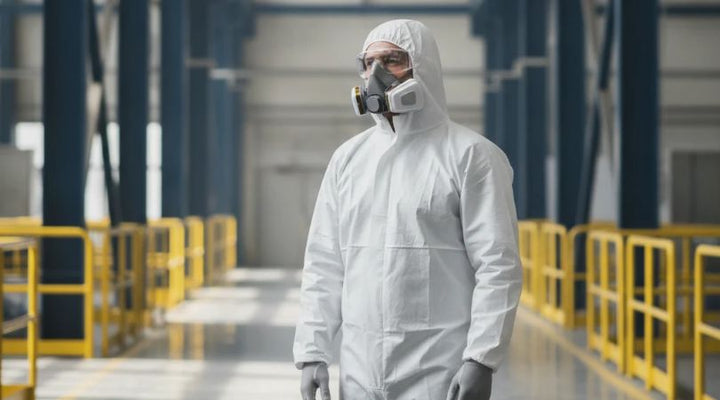
A good paint suit is a hooded, full-body disposable coverall that keeps overspray, sanding dust, and light splash off skin and clothes. At CACO America, we tell painters to check four things: hood and foot coverage, a smooth low-shed fabric, a Type 5 and Type 6 rating on the product page, and a size that fits over work clothes.
Below, I explain each feature, compare the two GE PPE suits we carry for spray work, and draw a line where a paint suit stops being enough. I have worked in this business since 1992, and the same mistake keeps coming up: crews treat any white suit as protection against anything in the can.
What a paint suit actually does
A painting suit has a narrower job than most people assume. It keeps three things off the painter: fine overspray mist that settles on hair, arms, and shoulders; dry dust from sanding between coats; and the drips and light splash that come with rolling ceilings or cleaning guns.
It also protects the work. Street clothes and worn cotton shed fibers and carry dust, and both end up in a wet finish. A clean suit pulled on at the booth door keeps that debris on the outside of the job.
What it does not do is stop chemicals from passing through. Our broader industrial coveralls guide covers woven garments, FR clothing, and hi-vis. This post stays with disposables.
Four features painters should check
1. Hood and boots
Overspray finds every gap. A suit without a hood leaves the neck and hairline open, and that is where mist collects during overhead work. Attached boots close the other gap, at the ankle, and stop paint from tracking off the booth floor. If the suit has no boots, the ankle cuff needs to seal snugly over footwear.
2. Fabric that sheds less
Lint is a finish problem, not only a comfort one. Painters want a smooth nonwoven fabric that does not fuzz up during the shift. Neither of our GE suit pages publishes a lint test, so if your finish spec requires low-lint garments, ask for documentation before you standardize a booth on one style.
3. Type 5 and Type 6 ratings
These are European chemical protective clothing types, and they mean specific things. ISO 13982-1 defines Type 5 as full-body clothing resistant to penetration by airborne solid particles. EN 13034 defines Type 6 as limited protection against light spray, liquid aerosols, and low-pressure, low-volume splashes. That second scope matters: EN 13034 states that a complete permeation barrier at the molecular level is not required. Type 6 resists mist. It is not a chemical barrier.
4. Closure and cuffs
Look for a two-way zipper under a sealable flap, plus elastic at the hood, wrists, waist, and ankles. Those details decide whether the barrier holds while the painter reaches and bends.
Paint suit checklist
| Suit Feature | Why Painters Need It | What to Check |
|---|---|---|
| Integrated Hood | Overspray can settle on hair and neck during overhead painting work. | Elastic hood edge designed to fit around the face and compatible goggles. |
| Attached Boots or Sealed Ankles | Helps prevent paint tracking and keeps overspray off socks and footwear. | Integrated boots or elastic ankle closures that fit securely over footwear. |
| Smooth, Low-Shed Fabric | Loose fabric fibers can become trapped in wet paint and affect the finish. | Ask the supplier for lint-shedding data if your specification requires it. |
| Type 5 Rating | Provides protection against hazardous dry particles, including sanding dust and powder between coats. | ISO 13982-1 compliance stated in the product documentation. |
| Type 6 Rating | Designed for limited protection against light spray mist and low-volume liquid splashes. | EN 13034 compliance stated in the product documentation. |
| Two-Way Zipper with Sealable Flap | The front closure is a potential entry point for paint mist and contaminants. | Protective flap that fully covers and securely closes over the zipper. |
| Size Chart by Chest, Height, and Weight | A tight-fitting suit can split around the seat and shoulders during movement. | Check that the size chart accommodates your crew's height range and allows room for clothing underneath. |
GW903 or GW904: two GE paint suits
CACO America carries two microporous disposable suits whose product pages list painting and surface coating as intended uses. Both use 63 GSM microporous fabric, both list Type 5 under ISO 13982-1 and Type 6 under EN 13034, and both come 24 to a case in sizes S to 3XL.
The GE PPE GW903 coverall with hood and boots is the head-to-toe option. Its integrated hood and attached boots suit booth spraying and ceiling work, where mist reaches everything.
The GE PPE GW904 hooded coverall skips the boots and uses elastic ankles, so painters can wear their own footwear. Its page also lists EN 1149-5 electrostatic properties. That standard covers dissipative clothing worn as part of a total earthed system, so the wearer must be grounded too. An antistatic rating is not flame resistance.
For dry prep work without spray, the GW903 page points buyers to the lighter GW900 SMS coverall. Our sibling post on the Tyvek suit versus microporous coveralls question compares the fabric families in more depth (Tyvek is a DuPont trademark).

Sizing a painters coverall over your clothes
Painters wear the suit over work clothes, so size for what goes underneath. ISEA publishes ANSI/ISEA 101-2014 (R2019), the size and labeling standard for limited-use and disposable coveralls. Neither GE page cites it, so we size these two suits from the product page charts.
Both charts list chest, height, and weight. Size L, for example, covers a 39 to 43 inch chest, 5 feet 8 inches to 6 feet tall, and 150 to 200 pounds. My rule is simple: match height first, then chest, and go up a size if the painter wears a hoodie or a winter layer underneath.
Then do a quick fit check in the suit. Squat, reach both arms overhead, and kneel. The seat should not pull, the zipper should not strain, and cuffs should stay over the glove and boot line. OSHA requires employers to select PPE that properly fits each affected employee. A suit that binds gets unzipped, and an unzipped suit protects nobody.

When to change a disposable paint suit
Both GE suits are single use, and their pages say not to launder or reuse them. Beyond that, the triggers are practical:
- Torn or split seams.A tear at the crotch or underarm is an open door for mist. Change it now, not at lunch.
- Saturated areas.If paint has soaked through a sleeve or knee, the barrier is gone in that spot.
- Broken zipper or flap.If the front will not close, the suit is finished.
- Leaving the work area.Take the suit off before breaks and meals, and put on a fresh one when you return.
- End of shift.Bag it and toss it. Never take a used suit home in the truck.
Budget at least one suit per painter per shift, plus spares. Pair them with safety goggles and disposable nitrile gloves so the kit closes at the face and hands.
"A paint suit is a drop cloth you wear. It keeps mist off you and lint off the job. The minute someone treats it like chemical armor, I stop the order and ask what is in the can." Joel Abbo, CEO, Caco Abbo Group
Where a paint suit stops protecting
Some coatings need far more than a disposable suit. OSHA's isocyanates overview names painting among the jobs that may involve isocyanate exposure. It lists occupational asthma and skin irritation among the main health effects. Polyurethane paints are one of the products it ties to these compounds.
Start with the coating's safety data sheet. OSHA's SDS brief explains that Section 8 covers exposure limits, engineering controls, and PPE, including any special requirements for protective clothing or respirators. Feed that into the employer's written hazard assessment, which our PPE hazard assessment guide walks through step by step.
If the SDS calls for chemical-resistant clothing, follow it, and do not substitute a Type 6 suit. The same goes for respirators. CACO America does not sell respirators, so that piece comes from your respiratory protection supplier and program.

Stocking paint suits for your accounts
For distributors, disposable paint suits move like consumables. Painting contractors and maintenance crews burn through cases on a steady cycle, so set the reorder cadence at the first sale and hold depth in L, XL, and 2XL before adding a second style.
We hold the exclusive GE PPE license across the Americas and the Caribbean, and we supply distributors in more than 38 countries. Both suits sit in our protective clothing range with gloves and eyewear, so one order can kit a whole crew.
Ready to put the right suit on your painters? Compare every disposable option in our industrial coveralls collection, or apply to become a CACO distributor for case pricing.
Frequently asked questions
What is a paint suit?
A paint suit is a disposable, full-body coverall worn during painting and spraying to keep overspray, sanding dust, and light splash off skin and clothes. Most include a hood, and some add attached boots. It protects the finish as well as the painter, because it keeps lint and dust from street clothes out of wet paint. It is not chemical-resistant clothing.
Do painters need Type 5 or Type 6 coveralls?
For spray work, look for both. Type 5 (ISO 13982-1) covers airborne solid particles such as sanding dust. Type 6 (EN 13034) covers light spray, aerosols, and low-volume splash. Together they match most overspray and prep exposures. Check that the product page names the standards, and remember that Type 6 does not mean the suit blocks chemical permeation.
Is a disposable paint suit enough for isocyanate or polyurethane spray coatings?
Not by default. OSHA lists painting among the jobs that may involve isocyanate exposure, and these coatings can require specific clothing and respiratory protection. Read Section 8 of the coating's SDS and follow the employer's hazard assessment. If either calls for chemical-resistant clothing or a respirator, a standard paint suit is not a substitute.
How should a painting suit fit?
Loose enough to squat, kneel, and reach overhead without the seat pulling or the zipper straining. Size by height first, then chest, and go up a size if you wear layers underneath. Cuffs should stay over gloves and boots during movement. A suit that is too tight tends to split at the crotch or shoulders mid-shift.
Can you reuse a disposable paint suit?
No. Disposable suits like the GE PPE GW903 and GW904 are labeled single use, and their product pages say not to launder or reuse them. Change the suit when it tears, when paint soaks through, when you leave the work area for a break, and at the end of every shift. Bag used suits for disposal.
Should I choose a paint suit with attached boots?
Choose attached boots when overspray reaches the floor, such as booth spraying or ceiling work, or when tracking paint is a problem. They close the ankle gap completely. Choose a hooded suit with elastic ankles, like the GW904, when painters prefer their own footwear and floor contact is light. Either way, keep the hood up during spraying.
What else should painters wear with a paint suit?
Pair the suit with safety goggles to keep mist out of the eyes and disposable nitrile gloves tucked under or over the cuffs. Respiratory protection depends on the coating, so check the SDS and the employer's hazard assessment. CACO America supplies the suits, goggles, and gloves, but does not sell respirators.