Workers need impact gloves whenever the back of the hand sits in the path of a moving load: pipe and tongs on a rig floor, swinging steel during a lift, dropped tools and pinch points in construction. Buy a glove with a marked ANSI/ISEA 138 impact level, then match its ANSI/ISEA 105 cut level to the edges on site.
Buyers who ask CACO America for oil field gloves usually ask the follow-up in the same breath: will it stop a cut too? It can, if you read two numbers instead of one.
I joined our family business in 1992, and in more than thirty years I have watched hand protection move from leather and luck to tested, labeled performance. Caco Abbo Group now holds the exclusive General Electric (GE) PPE license across the Americas and the Caribbean and supplies distributors in more than 38 countries. With impact gloves, the label matters most. Two pairs can look identical on a peg and protect very differently on a hand.
Why the back of the hand takes the hit
The palm grips. The back of the hand leads, so the knuckles and fingers are the first thing an object meets. The International Safety Equipment Association (ISEA) names dorsal, or back-of-hand, injuries as the biggest risk in its white paper on impact-resistant hand protection: fractures, bruising, and pinched fingers. It also notes that a crushed bone, among the hand's 27, is harder to treat than a clean break.
Fatality data does not break out hands, but it shows which events dominate. The Bureau of Labor Statistics counted 756 deaths from contact incidents in 2024 in its Census of Fatal Occupational Injuries, Table 2, and 357 of them were workers struck by a propelled, falling, or suspended object. At lower energy, those same events are what impact gloves are built for.

Pinch, struck-by, and crush are three different injuries
OSHA's construction training separates these on purpose. Its struck-by hazards lesson defines a struck injury as one "produced by forcible contact or impact" between a person and an object. The test is simple. If impact alone caused the injury, it is struck-by. If crushing between objects caused it, it is caught-in or caught-between.
That distinction decides what a glove can and cannot do:
- Struck-by.A dropped hammer, a swinging hook, a pipe that rolls. TPR guards spread and absorb the blow. This is the core job of an impact glove.
- Pinch points.Fingers between a load and a frame edge, or between two joints of pipe. Finger bumpers and padding help with light pinches and glancing contact.
- A hand trapped under a load or between two heavy objects. No glove stops that. Hand placement, tag lines, and push tools do.
Being honest about the third bullet is what separates a safety program from a glove order.
Where impact resistant work gloves earn their keep
ISEA lists offshore oil and gas, construction, mining, manufacturing, warehousing, and transport as industries particularly susceptible to hand-impact injuries. Three of them shape most impact specs.
Oil and gas
Rig floors mean heavy steel, wet decks, and constant handling of pipe, tongs, and slips. ISEA's white paper cites International Association of Drilling Contractors data for 2018: fingers and hands or wrists made up 29.47 percent of lost-time incidents by body part across the drilling industry. Oil field gloves need impact guards, a palm that grips through oil and mud, and visibility for low light. The rest of the kit is on our oil and gas PPE page.
Rigging and lifting
Riggers guide suspended loads and work beside the pinch point between load and sling. A load that shifts is a struck-by event looking for a target. Gloves handle glancing hits. Tag lines keep hands out of the line of fire.
Construction trades
Ironworkers, formwork crews, and demolition teams take dropped tools, swinging material, and rebar ends. Most of those tasks carry cut exposure too, so impact alone rarely settles the spec.

How TPR guards work
TPR is thermoplastic rubber, a material that molds like plastic and flexes like rubber. Manufacturers shape it into raised pads over the knuckles, the backs of the fingers, and sometimes the thumb, then stitch or bond those pads to the shell. When an object strikes, the pad deforms and spreads the load across a wider area, so less force concentrates on the bones underneath.
Two design details decide whether that works on a shift:
- A guard that stops at the knuckles leaves the fingers bare, and pinch points tend to find fingers.
- Guards split into sections let the hand close into a fist without fighting the pad. A guard that is too stiff gets the glove pulled off, and a glove in a back pocket protects nothing.
TPR on its own proves nothing, though. The only way to know how much force a guard stops is the lab test behind ANSI/ISEA 138.
Reading the ANSI/ISEA 138 label
ISEA released ANSI/ISEA 138-2019 in February 2019 as the first North American standard to address impact injuries to the hand. It defines one test method, three performance levels, and a pictogram for each level. Testing must happen in a laboratory accredited to ISO/IEC 17025.
The test strikes the knuckles four times and the fingers and thumb five times on each glove, then compares the averages. The worse of the two averages becomes the score. Because the test measures force that passes through the glove, a lower number means better protection:
- Level 1:mean transmitted force of 9 kN or less
- Level 2:5 kN or less
- Level 3:4 kN or less, the highest protection
So level 2 knuckles on level 1 fingers make a level 1 glove.
OSHA's hand protection rule, 29 CFR 1910.138, lists cuts, abrasions, punctures, and burns but never names impact. It does require employers to select gloves based on the hazards identified for each task. A documented PPE hazard assessment is where back-of-hand impact earns its line on the spec.
Hazard, protection, and label check
| Hazard | What Protects | What to Check on the Label |
|---|---|---|
| Pinch Point | Finger bumpers, a padded back, and keeping fingers clear of closing gaps. | TPR coverage across the fingers, not just the knuckles. |
| Struck-By | Impact-tested TPR knuckle and finger guards. | ANSI/ISEA 138 impact protection level 1, 2, or 3. Select a suitable level based on the task and impact exposure. |
| Crush | Safe hand placement, tag lines, and push tools to keep hands away from heavy loads. | No glove rating covers crush hazards. Use appropriate equipment, work procedures, and hazard controls. |
| Cut | A cut-resistant liner (HPPE, glass fiber, or steel blends) or appropriately rated leather. | ANSI/ISEA 105 cut-resistance level, A1 through A9, matched to the cutting hazard. |
Impact plus cut: picking one glove for both
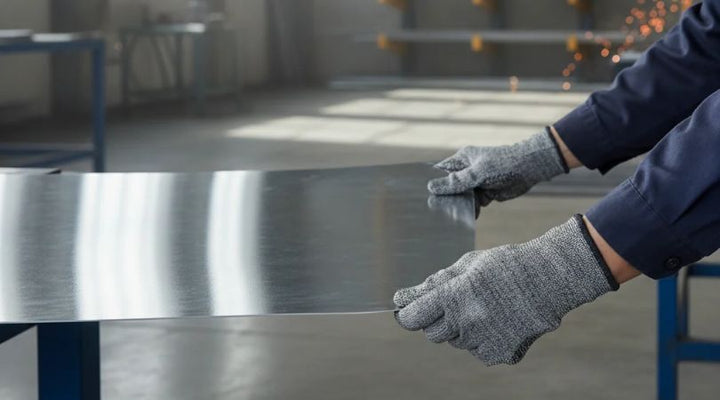
Most impact hazards travel with edges. Pipe threads, sheet steel, and rebar cut while they hit. The cut side runs on a separate standard, ANSI/ISEA 105-2024, scored A1 to A9. ISEA groups the levels in plain terms: A1 to A3 for scrapes, A4 to A6 for cuts that would need stitches, and A7 to A9 for the most severe exposures.
Work the spec in this order. Set the impact level from the heaviest likely strike. Set the cut level from the sharpest edge the worker actually touches. Then choose grip, cuff, and visibility for the site. Skipping the middle step is how a crew ends up with knuckle armor and a sliced palm.
Our guide to the best cut-resistant gloves by task pairs common jobs with cut levels. Where the hazard is cut only, a cut resistant glove without TPR breathes better and costs less.

Three GE PPE impact gloves, matched to the job
All three carry the GE PPE name, and every spec below comes from the live product page.
GG240: sandy nitrile, TPR Impact 1, cut A3
The Sandy Nitrile TPR Impact Work Gloves (GG240) use a 13-gauge liner of HPPE, polyester, glass fiber, and spandex, dipped in black sandy nitrile for grip around oil. The page lists TPR Impact 1 protection, ANSI cut level 3, a reinforced thumb crotch, and a longer cuff, in sizes S to 2XL. It suits maintenance and general construction, where strikes are lighter.
GG422: hi-vis synthetic leather, TPR Impact 2, cut A4
The Hi-Vis TPR Impact Resistant Cut A4 Work Gloves (GG422) are built for oil and gas: synthetic leather, a non-slip abrasion-resistant palm for wet conditions, reflective hi-vis, TPR Impact 2 protection, and ANSI cut level 4. The page also lists EN 388 and CE certification. Sizes run M to 2XL.
GG421: leather driver, TPR Impact 2, cut A7
The A7 Cut and Impact Resistant Driver Gloves (GG421) pair a goatskin and cowhide shell with TPR Impact 2 guards and ANSI cut level A7. A reinforced palm, keystone thumb, and shirred elastic wrist round it out, with EN 388 and CE certification, in sizes M to 2XL. Pick it when sheet metal or glass edges sit right next to the impact hazard.
One note for safety managers: these pages list impact protection as TPR Impact 1 or 2. When your written assessment calls for a specific ANSI/ISEA 138 level, confirm the pictogram on the glove and keep that record on file.
"If a crew can't tell me what the number on the back of their glove means, they bought it for the look. Rubber that was never tested is decoration, and decoration does not set bones." Joel Abbo, CEO, Caco Abbo Group
Fit, wear, and the one place to take gloves off
Fit matters more on an impact glove than most. Too loose, and the guard slides off the knuckle it should cover. Too tight, and the TPR fights every grip until the glove comes off. Our mechanics gloves guide walks through the knuckle measurement and closed-fist check, and the method carries over unchanged.
Retire a pair when a guard tears loose, the palm wears through, or the cuff stops holding. Then follow the hard rule. OSHA's machine safeguarding guide warns that clothing, jewelry, long hair, "and even gloves" can get entangled in moving machine parts. At a lathe, drill press, or running roller, the glove becomes the hazard.
Spec impact gloves your crews will actually wear
The right impact glove has a tested level, a cut rating matched to the edges, and a fit that stays on all shift. Compare TPR levels, cut ratings, and sizes side by side across our impact-resistant gloves range. Distributors serving rigs, steel erectors, or general contractors can open a CACO America distributor account and stock the GE PPE line their safety managers already recognize.
Frequently asked questions
What are impact gloves?
Impact gloves are work gloves with molded guards, usually thermoplastic rubber, across the knuckles and the backs of the fingers. The guards spread and absorb blows from dropped tools, swinging loads, and moving pipe. Tested models carry an ANSI/ISEA 138 level from 1 to 3. They do not protect against crush injuries, and they are not cut resistant unless they also carry an ANSI/ISEA 105 cut level.
What do the ANSI/ISEA 138 levels mean?
The levels report how much force passes through the glove in a lab impact test, so a lower force earns a higher level. Level 1 allows a mean transmitted force of 9 kN or less, level 2 allows 6.5 kN or less, and level 3 allows 4 kN or less. The knuckles and the fingers are tested separately, and the glove takes the score of its weaker zone.
Are impact gloves also cut resistant?
Only if the label says so. Impact and cut protection come from different parts of the glove and different standards. The TPR guards handle impact under ANSI/ISEA 138, while a cut-resistant liner or rated leather handles edges under ANSI/ISEA 105, scored A1 to A9. Many impact gloves carry both ratings, such as gloves listed at cut A3, A4, or A7, but never assume one implies the other.
What gloves do oil field workers wear?
Oil field gloves typically combine back-of-hand impact guards, a palm that grips through oil and mud, cut resistance matched to pipe threads and steel edges, and hi-vis color for low light. ISEA cites drilling-industry data showing that fingers and hands or wrists made up 29.47 percent of lost-time incidents by body part in 2018, which is why rig crews treat impact guards as standard equipment.
Can impact gloves prevent crush injuries?
No. Impact gloves are tested for strikes on the back of the hand, not for a hand trapped between heavy objects. OSHA's training separates struck-by injuries, caused by impact alone, from caught-in or caught-between injuries, caused by crushing. Crush hazards call for controls that keep hands out of the gap: tag lines, push tools, guarding, and clear rules about never placing hands under a suspended load.
Should you wear impact gloves near rotating machinery?
No. OSHA's machine safeguarding guidance warns that gloves, like loose clothing and jewelry, can get entangled in moving machine parts. A thick impact glove offers more material for a spindle or roller to grab. Remove gloves before working at lathes, drill presses, roll-forming machines, or any running equipment, and rely on machine guards and lockout procedures for protection instead.