The best cut resistant gloves match the hazard in front of the worker. At CACO America, our picks run A3 polyurethane for box cutting and warehouse work, A4 micro foam nitrile for HVAC and drywall, A6 for sheet metal and glass, and A7 leather with impact guards for heavy fabrication. One glove per task, chosen by level, coating, and grip.
I have worked in PPE for more than 30 years, since I joined our family business in 1992. Today Caco Abbo Group holds the exclusive General Electric (GE) PPE license across the Americas and the Caribbean and supplies distributors in more than 38 countries. The most common glove mistake I see has not changed in three decades: one glove bought for every task in the building. This roundup fixes that, one job at a time, using five gloves from our cut resistant gloves collection.
How we picked: level, coating, and grip
Every pick below answers three questions. First, the cut level. ANSI/ISEA 105-2024 rates cut resistance from A1 to A9 by the grams of blade force needed to cut through the material: A3 starts at 1,000 g, A4 at 1,500 g, A5 at 2,200 g, A6 at 3,000 g, and A7 at 4,000 g. The test method is ASTM F2992-23.
ISEA groups those levels into three bands. A1 to A3 protect against scrapes. A4 to A6 protect against cuts that would need stitches. A7 to A9 are meant for brutal or extreme injuries.
Second, the coating, which decides grip on the surface the worker actually touches. Third, the fit and feel, because a glove that fights the fingers comes off.
One rule holds across all five picks. No glove is cut proof. A rating measures resistance in a lab test, so it buys margin, never immunity. Keep every one of these gloves away from moving or powered blades.
The picks at a glance
The table pairs each task with the level we recommend, the coating that fits the surface, and the one CACO glove we would hand that crew. Every cut level and coating comes from the live product page.
| Task | Recommended ANSI Cut Level | Coating and Grip Need | CACO Pick |
|---|---|---|---|
| Box Cutting and Warehouse Picking | A2 to A4 | Thin polyurethane, dry grip, and good fingertip feel | GG207 – ANSI A3, Gray PU |
| HVAC Ductwork, Drywall, and Light Assembly | A4 to A5 | Micro foam nitrile with reinforced thumb crotch | GG224 – ANSI A4, Black Micro Foam Nitrile |
| Sheet Metal Handling (Dry Stock) | A5 to A6 | Polyurethane coating for dry and slightly oily stock | GG201 – ANSI A6, Gray PU |
| Glass Handling | A5 to A7 | Foam nitrile coating for smooth, slick surfaces | GG226 – ANSI A6, Black Foam Nitrile |
| Heavy Fabrication, Stamping, Oil and Gas | A7 + Impact | Leather palm with TPR knuckle guards | GG421 – ANSI A7, Impact Level 2 |

Box cutting and warehouse work
The hazard
Utility knives, box straps, and cardboard edges make up most of the cut exposure in a warehouse. The typical injury is a slice from a slipped knife or a paper-edge cut across the palm. ISEA's Key to Hand Classifications lists packaging, warehouse, and general material handling among the applications at the low end of the scale.
Recommended level and grip
We recommend A2 to A4 here. A2 covers pure handling. Knife-heavy receiving docks should sit closer to A3 or A4. The grip need is modest: dry cardboard and shrink wrap, plus the ability to work a scanner or peel a label.
The CACO pick: GG207
The A3 Cut Resistant Safety Gloves (GE PPE GG207) carry an ANSI Cut Level 3 rating on a 13 gauge liner of HPPE, nylon, spandex, glass fiber, and polyester. The gray polyurethane coating keeps the palm thin, so pickers keep their fingertip feel. A longer cuff adds wrist coverage, and the glove runs from S to 2XL. It is the glove a picker will still be wearing after lunch.
HVAC ductwork, drywall, and light assembly
The hazard
Duct sections, metal studs, drywall corner bead, and stamped brackets bring a real edge into the job without the full weight of a fabrication shop. These cuts can need stitches, which puts the work in ISEA's middle band. ISEA's key lists drywall work, electrical, and HVAC among its applications in that range.
Recommended level and grip
A4 to A5 fits most of this work. The grip challenge is variety: painted duct, dusty board, and small fasteners in the same hour. The thumb crotch also takes a beating from repeated pinching and screwing.
The CACO pick: GG224
The Micro Foam Nitrile Dipped Cut Level 4 Gloves (GE PPE GG224) carry ANSI Cut Level 4 on a 13 gauge liner of HPPE, polyester, steel, and spandex. The black micro foam nitrile coating grips across mixed surfaces, and the reinforced thumb crotch protects the highest-wear zone. The product page lists glass and metal handling, electronic assembly, woodworking, warehousing, and construction as uses. Sizes run M to XL.
Sheet metal gloves
The hazard
Sheet metal is the classic cut injury. A sheared or punched edge acts like a long, thin blade, and the cut usually happens when a sheet slides through the hands during a lift. Burrs add puncture risk on top. This is stitches-level exposure all day, and it sits in the A4 to A6 band.
Recommended level and grip
For production sheet handling, we recommend A5 to A6. Light HVAC fab can live at A4, but a shop moving blanks off a shear all shift needs the margin. Stock that is dry or lightly oiled calls for a coating with real feel, so the worker can sense a sheet starting to slip.
The CACO pick: GG201
The A6 Cut Resistant Safety Gloves (GE PPE GG201) are rated ANSI Cut Level 6. The 13 gauge liner blends HPPE, steel wire, basalt, spandex, and polyester, and the gray polyurethane coating is built for a secure grip in dry and slightly oily conditions. A longer cuff covers the wrist, where sheet edges often catch. Sizes run M to XL, in 12 packs or hanging cards.

Glass gloves
The hazard
Glass combines a razor edge with a slick face. A glazier carrying a panel has two problems at once: the edge cuts if the sheet shifts, and the smooth surface makes shifting likely. ISEA's key lists glass handling within its stitches band and glass and window manufacturing at the upper levels.
Recommended level and grip
We recommend A5 to A7 for glass. Light bottle work can sit lower. Plate glass, glazing, and window lines belong at the top of that range. The coating has to hold a smooth, sometimes wet surface, which favors foam nitrile over a thin PU film.
The CACO pick: GG226
The Cut Level 6 Foam Nitrile Dipped Gloves (GE PPE GG226) carry ANSI Cut Level 6 on a 13 gauge liner of HPPE, steel, basalt, polyester, and spandex. The black foam nitrile coating adds grip, and the reinforced thumb crotch handles the pinch hold glass carriers use. The product page names glass and metal handling first among its uses. Sizes run S to 2XL, including a longer cuff.
Metal working gloves for heavy fabrication
The hazard
Stamping lines, steelwork, and oil and gas sites stack two hazards. Sharp metal threatens the palm, while pinch points, swinging pipe, and dropped parts hit the back of the hand. A cut rating does nothing for a crushed knuckle. That second hazard has its own standard, ANSI/ISEA 138, which ISEA describes as setting testing, classification, and labeling requirements for back-of-hand impact protection.
Recommended level and grip
We recommend A7 plus a stated impact level here. ISEA's key places sharp metal stampings in the severe band. The grip need is heavy: tools, chain, and steel stock, often in all weather.
The CACO pick: GG421
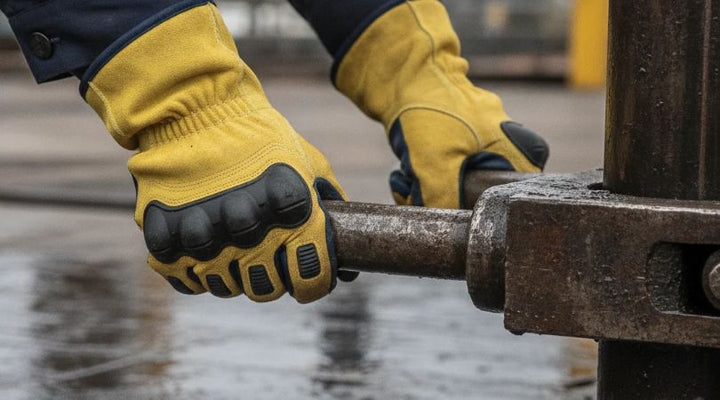
The A7 Cut & Impact Resistant Driver Gloves (GE PPE GG421) pair ANSI Cut Level A7 with TPR Impact Level 2 knuckle guards. The shell blends goat skin and cowhide leather, with a stitched reinforced palm, a keystone thumb, and a shirred elastic wrist. Sizes run M to 2XL. For more impact styles, see our impact resistant gloves collection.
Coating and grip: why the same level feels different
Two gloves at the same cut level can behave nothing alike on the job, and the coating is usually why. Here is how the four finishes in this roundup split.
- Polyurethane (GG207, GG201).A thin film with the most fingertip feel. Best on dry or lightly oiled surfaces where the worker needs to sense the part.
- Micro foam nitrile (GG224).A fine foam finish that grips across mixed surfaces. A good all-rounder for trades that switch materials often.
- Foam nitrile (GG226).A heavier foam built for grip on smooth, slick faces like glass.
- Leather (GG421).Not a dip at all. A full leather shell for heavy stock, tools, and outdoor work, paired with impact guards.
If a crew complains about grip, change the coating before you change the cut level. Our sibling post on cut level 4 vs cut level 5 gloves covers the step between the middle levels in more depth.

Do not over-buy the cut level
Higher is not automatically safer. A6 on a warehouse picker costs more, runs warmer, and feels thicker than the job needs. Gloves that feel wrong come off, and a bare hand has no cut rating at all.
OSHA puts selection on the employer. Under 29 CFR 1910.138, employers must base hand protection on the tasks performed, the conditions present, the duration of use, and the hazards identified. That reads like a task-by-task roundup for a reason.
The practical move is simple. Map each role to its sharpest regular contact, buy the level for that, and keep a higher-rated pair on hand for the occasional heavy job. Our guide on how to choose work gloves walks the same hazard-first logic across every glove family.
"Stop buying one glove for the whole plant. The picker and the glazier are not doing the same job, and a single SKU guarantees one of them is wearing the wrong pair." Joel Abbo, CEO, Caco Abbo Group
Inspection and replacement
A cut rating belongs to an intact glove. Once yarns pull, coatings crack, or a thin spot opens in the palm, the glove no longer performs at its tested level. The GG207 product page puts it plainly: inspect gloves for cuts or wear before every use.
Build three habits into the program:
- Inspect at the start of every shift.Holes, pulled yarns, and worn fingertips retire a pair on the spot.
- Keep coatings clean and dry.The GG201 page advises this to maintain grip and extend glove life, and to avoid harsh chemicals.
- Replace on a schedule for high-wear roles.Sheet metal and glass crews wear through palms faster than warehouse teams.
Pair the glove change with the rest of the kit. Crews facing pinch points and dropped loads should read our companion guide to impact resistant gloves, which explains how ANSI/ISEA 138 levels work.
Build your glove lineup by task
Five tasks, five gloves, one clear reason for each. That is how we want distributors and safety managers to buy hand protection: by the work, not by habit. Every pick here belongs to our GE PPE line, so one supplier covers the full range from the warehouse floor to the stamping line.
Ready to match a glove to every station on your floor? Shop the full cut resistant gloves lineup and compare all levels side by side, or ask our team for wholesale pricing on case quantities.
Frequently asked questions
What are the best cut resistant gloves for sheet metal?
For production sheet metal handling, we recommend ANSI A5 to A6 with a coating that grips dry or lightly oiled stock. Our pick is the GE PPE GG201, rated ANSI Cut Level 6 with a gray polyurethane coating built for dry and slightly oily conditions. Light HVAC fabrication can step down to A4, but shear and press work needs the extra margin.
What cut level do I need for glass handling?
We recommend A5 to A7 for glass, with plate glass and glazing at the higher end. ISEA's guidance places glass handling in its stitches band and glass and window manufacturing at higher levels. Coating matters as much as level, since glass is smooth. Foam nitrile, as on the GG226 (ANSI Cut Level 6), helps hold a slick surface.
Are cut resistant gloves cut proof?
No. Every glove on the market is cut resistant, not cut proof. The ANSI/ISEA 105 rating measures how many grams of blade force it takes to cut through the material in a lab test. A higher level buys more margin and reaction time, never immunity. Never use cut resistant gloves near moving or powered blades.
Which cut level is right for box cutting and warehouse work?
A2 to A4 covers most warehouse work. Pure handling sits at A2, while receiving docks that use utility knives all day should move up to A3 or A4. Our pick is the GG207, rated ANSI Cut Level 3 with a thin gray polyurethane coating, which keeps fingertip feel high enough for scanning, labeling, and opening cartons.
What is the difference between ANSI A5 and A6?
Under ANSI/ISEA 105-2024, A5 covers materials that need 2,200 to 2,999 grams of blade force to cut through, while A6 starts at 3,000 grams and runs to 3,999. Both sit in ISEA's stitches band. A6 suits heavier sheet metal and glass work. A5 fits lighter metal fabrication where dexterity matters more.
Do I need impact protection with cut resistant gloves?
Only when the back of the hand faces hits. Cut ratings cover the palm and fingers against blades, not crushing or striking forces. If the job involves pinch points, swinging pipe, or dropped steel, choose a glove rated under ANSI/ISEA 138 for impact as well. Our GG421 pairs ANSI A7 cut resistance with TPR Impact Level 2 knuckle guards.