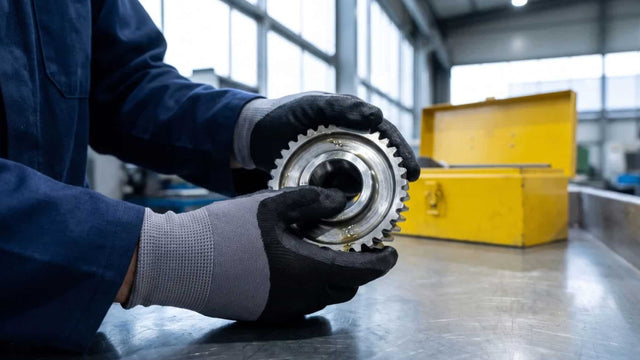
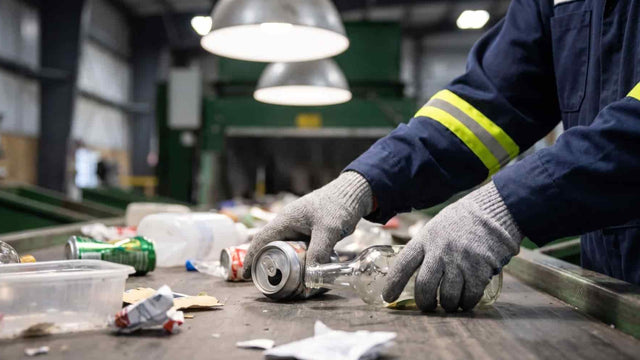
The powered hand tools on this chart run between 95 and 113 dBA at or near the operator. A jackhammer measures 102 to 111 dBA. A worm drive circular saw reads 95 to 112 at the ear, depending on the blade. All of them pass OSHA's 90 dBA limit quickly. This decibel chart from CACO America shows how quickly.
I joined our family business in 1992, and I have spent more than 30 years in PPE since. We hold the exclusive General Electric PPE license across the Americas and the Caribbean and supply distributors in more than 38 countries. Every tool level below comes from a named, published measurement, and every exposure time is arithmetic on the federal formulas. Nothing is rounded up to sound scary.
How to read a decibel chart
Decibels run on a logarithmic scale. OSHA's own construction noise training puts it simply: a 3 dB increase doubles the sound energy, and a 10 dB increase multiplies it tenfold. So a 105 dBA saw carries ten times the energy of a 95 dBA loader, even though the numbers look close.
Two more details matter when you read decibel levels. The "A" in dBA means the meter is filtered to match how the ear responds, and every workplace limit uses it. NIOSH also offers a field test you can run without a meter. At about 85 dBA, you have to raise your voice to be heard by someone 3 feet away. By 95 dBA, you have to shout.
Keep one distinction in mind. A sound level is a single reading. The time-weighted average (TWA) blends levels across a shift, and noise dose is the percent of the daily allowance a worker has used. A dose of 100 percent means the day's limit is gone.
Sound power and sound pressure
Some tool specs list sound power, which describes the tool itself, while exposure limits apply to sound pressure at the ear. NIOSH's power tool research found that loading a tool raised sound power by 4.1 dBA on average across all tools tested, and by 7.6 dBA for circular saws. When you compare tools, use the loaded figure. Keep sound power values off the 85 and 90 dBA lines, though, because those limits apply only to sound pressure.
Decibel chart of common job site tools
The chart below combines two published sources. CPWR, the Center for Construction Research and Training, measured the equipment ranges. A Build It Smart noise checklist, which CPWR republished, measured the hand tools at the operator's ear.
| Tool or Equipment | Typical dBA (Source) | OSHA Permissible Time (PEL: 90 dBA, 5 dB Rule) | NIOSH Recommended Time (REL: 85 dBA, 3 dB Rule) | Estimated NRR Needed to Reach 85 dBA |
|---|---|---|---|---|
| Pneumatic chip hammer | 103 to 113 (CPWR) | 20 min to 1 hr 19 min | 45 sec to 7 min 30 sec | PPE short |
| Worm drive circular saw | 95 to 112 (BIS, at ear) | 23 min to 4 hr | 56 sec to 48 min | 27 to PPE short |
| Jackhammer | 102 to 111 (CPWR) | 26 min to 1 hr 31 min | 1 min 11 sec to 9 min | Dual to PPE short |
| Portable band saw, cutting metal | 104 (BIS, at ear) | 1 hr 9 min | 6 min | PPE short |
| Reciprocating saw, metal stud | 103 (BIS, at ear) | 1 hr 19 min | 7 min 30 sec | PPE short |
| 4-inch angle grinder | 101 to 103 (BIS, at ear) | 1 hr 19 min to 1 hr 44 min | 7 min 30 sec to 12 min | Dual to PPE short |
| Concrete joint cutter | 99 to 102 (CPWR) | 1 hr 31 min to 2 hr 18 min | 9 min to 19 min | Dual |
| Stud welder | 101 (CPWR) | 1 hr 44 min | 12 min | Dual |
| Bulldozer | 93 to 96 (CPWR) | 3 hr 29 min to 5 hr 17 min | 38 min to 1 hr 16 min | 23 to 29 |
| Earth tamper | 90 to 96 (CPWR) | 3 hr 29 min to 8 hr | 38 min to 2 hr 31 min | 17 to 29 |
| Crane | 90 to 96 (CPWR) | 3 hr 29 min to 8 hr | 38 min to 2 hr 31 min | 17 to 29 |
| Hammer | 87 to 95 (CPWR) | 4 hr to over 8 hr | 48 min to 5 hr 2 min | 11 to 27 |
| Front-end loader | 86 to 94 (CPWR) | 4 hr 36 min to over 8 hr | 1 hr to 6 hr 21 min | 9 to 25 |
| Backhoe | 84 to 93 (CPWR) | 5 hr 17 min to over 8 hr | 1 hr 16 min to over 8 hr | Up to 23 |
| Shop vacuum | 88 (BIS, at ear) | Over 8 hr | 4 hr | 13 |
| Normal conversation | About 70 (CPWR) | No limit | No limit | None |
Legend: CPWR = CPWR Hazard Alert, Construction Noise (2003). BIS = Build It Smart noise checklist (2001), as published by CPWR. Times run from the loud end of each range to the quiet end and assume steady exposure at that level. NRR estimate = 2 x (dBA minus 85) + 7, from OSHA's 50 percent derating. "Dual" = plug plus muff needed. "PPE short" = even dual protection leaves the worker above 85 dBA by this estimate.

Treat the times as ceilings, and never as a schedule. Both OSHA rules require feasible engineering or administrative controls whenever levels exceed the table, with PPE filling the gap.
How loud is a jackhammer?
A jackhammer runs 102 to 111 dB, according to CPWR's measured equipment levels. OSHA's 2003 construction noise presentation, citing NIOSH, lists the same range. An OSHA inspection sample in that presentation recorded 102 dBA for jackhammering across a 7.5-hour sample. Another recorded 112 dBA for a skid steer breaking pavement.
At 102 dBA, OSHA allows 1 hour 31 minutes a day. NIOSH recommends about 9 minutes.
Run the protection math at that lower end. A 32 NRR foam plug is worth an estimated 12.5 dB in the field. That leaves the operator near 89.5 dBA. Put an earmuff over the plug and OSHA's dual protection method adds 5 dB, for an estimate of 84.5 dBA. At the 111 dBA end, even dual protection leaves 93.5 dBA, so rotation and quieter equipment have to carry the rest of the load.
"Find the loudest tool on your site and do the subtraction before you order a single case of plugs. Past about 102 dBA, the fix is a quieter tool or less time on it, and I tell distributors exactly that." Joel Abbo, CEO, Caco Abbo Group
Safe exposure times: OSHA PEL vs NIOSH REL
The chart carries two time columns because the two agencies use different math. OSHA's 29 CFR 1910.95 sets 8 hours at 90 dBA and halves the time for every 5 dB, so T = 8 / 2^((L - 90) / 5). Construction follows the same Table D-2 under 29 CFR 1926.52, which caps continuous noise at 115 dBA for a quarter hour or less.
NIOSH starts at 85 dBA for 8 hours and halves the time every 3 dB, so T (minutes) = 480 / 2^((L - 85) / 3). The NIOSH criteria document explains why. Over a 40-year career, the excess risk of noise-induced hearing loss is 8 percent at 85 dBA and 25 percent at 90 dBA. Both agencies set 140 dB as the impulse ceiling.
Real shifts mix levels, and 1926.52 adds them up. Here is a hypothetical example: one hour on a jackhammer at 102 dBA, then six hours near a backhoe at 90 dBA. That gives 1/1.5 + 6/8 = 1.42, and anything above 1.0 exceeds the limit.
What NRR do you need for each tool?
The Noise Reduction Rating on the box is a lab number. The OSHA Technical Manual, Section III, Chapter 5 corrects it in two steps for A-weighted readings: subtract 7, then apply a 50 percent safety factor. Solve that for a target of 85 dBA and you get the chart's last column: NRR needed = 2 x (L minus 85) + 7.
A bulldozer at 96 dBA needs an NRR of 29. A grinder at 103 dBA works out to 43, which is higher than any rating in our range and well past what a single protector can deliver on its own. OSHA's dual method derates the higher-rated protector and adds 5 dB.
OSHA uses a lighter method when it checks hearing protector adequacy: subtract 7 and stop. I plan around the stricter estimate. Fit varies, and the 50 percent factor exists because label numbers ran high in the field. For the plug-or-muff decision itself, our earplugs vs earmuffs guide walks through comfort and compatibility.

Decibel levels by trade and distance
Concrete and demolition crews sit at the top of the chart. Chip hammers, jackhammers, and joint cutters all start near or above 99 dBA. Framers and finish carpenters live with the circular saw, and blade choice matters. In the Build It Smart test, a sharp carbide blade on a fir 2x6 read 95 dBA at the ear, against 107 for a dull conventional blade.
Ironworkers and metal trades face grinders, band saws, and reciprocating saws in a tight 101 to 104 dBA cluster. Equipment operators see lower but longer exposure. CPWR measured a crane at 96 dB while lifting a load and under 80 at rest.
Distance helps anyone nearby. A worm drive saw that read 112 dBA at the operator's ear dropped to 102 at 10 feet and 93 at 40 feet. A plywood barrier cut the 10-foot reading to 92. CPWR found an earthmover at 94 dB from 10 feet and 82 from 70 feet. Map who stands near each tool during your PPE hazard assessment.

Matching protection to the chart
Two GE PPE products cover most of the chart. The GP420 bullet-shaped foam earplugs carry a 32 dB NRR. They are uncorded and disposable, made of soft hypoallergenic polyurethane foam that expands slowly, and they come in a resealable bag of 5 pairs. They are dielectric, with no metal parts. By OSHA's derated estimate, a well-fitted pair handles steady exposures up to about 97.5 dBA.
The GM452 protective earmuff is an over-the-head muff rated 27 dB NRR. It has high-impact ABS cups, pivoting cups with soft pads, and a cushioned headband on stainless steel wires. The product page notes it can go over earplugs for double protection, which stretches the estimate to about 102.5 dBA.
Our best earplugs for work roundup covers corded and reusable plugs. Crews that need to talk through the noise should read our noise-cancelling earmuffs guide. Once the protectors are chosen, the OSHA hearing conservation program guide explains the training, testing, and records that go with them.
Print the chart, circle your three loudest tools, and size the order from there. Every plug, muff, and dual-protection pairing we carry sits in the CACO America hearing protection collection, with earplugs and earmuffs also listed on their own pages.
Frequently asked questions
What is a decibel chart?
A decibel chart lists common sounds or equipment next to their measured sound levels, usually in A-weighted decibels (dBA). Job site versions add the exposure limits, so a supervisor can see which tools cross OSHA's 90 dBA permissible limit or NIOSH's 85 dBA recommended limit. The most useful charts also show how long a worker can stay near each tool and what hearing protection the level calls for.
How loud is a jackhammer in decibels?
CPWR measured jackhammers at 102 to 111 dB, and an OSHA presentation citing NIOSH lists the same range. An OSHA inspection sample recorded 102 dBA over 7.5 hours of jackhammering. At 102 dBA, OSHA permits about 1.5 hours a day and NIOSH recommends about 9 minutes, so jackhammer operators need hearing protection, often doubled, plus rotation.
How many decibels is too loud at work?
NIOSH treats 85 dBA averaged over an 8-hour shift as hazardous, and OSHA requires a hearing conservation program at that same 85 dBA action level in general industry. OSHA's enforceable limit is 90 dBA for 8 hours. A quick field check from NIOSH: if you have to raise your voice to talk to someone 3 feet away, the noise is probably around 85 dBA or higher.
How long can you be exposed to 100 decibels?
Under OSHA's Table G-16 and Table D-2, 100 dBA is permitted for 2 hours a day. NIOSH's recommended limit is far shorter at 15 minutes, because NIOSH halves the allowed time every 3 dB instead of every 5 dB. Both figures assume no other noise exposure that day, so time spent near other loud tools uses up the allowance faster.
What NRR do I need for 100 dBA noise?
Using OSHA's derated method with a target of 85 dBA, the estimate is 2 x (100 minus 85) + 7, which equals an NRR of 37. No single protector in a typical range reaches that. Dual protection works here: a 32 NRR earplug under an earmuff gives an estimated 17.5 dB of field reduction, bringing 100 dBA down to about 82.5 dBA.
Do employers have to provide hearing protection on construction sites?
Yes. Under 29 CFR 1926.52, when sound levels exceed Table D-2 and feasible engineering or administrative controls fail to bring them down, the employer must provide personal protective equipment and ensure it is used. The same rule requires a continuing, effective hearing conservation program wherever levels exceed the table. General industry follows 29 CFR 1910.95, with a program required at 85 dBA.
Can a phone app measure decibels accurately?
A phone app gives a useful first read, but it may not meet regulatory requirements. NIOSH built its own Sound Level Meter app for iOS devices and still recommends Type 1 or Type 2 sound level meters for area surveys and personal dosimeters for worker exposure. Use an app to find the loud spots, then confirm with calibrated equipment before you set protection levels.