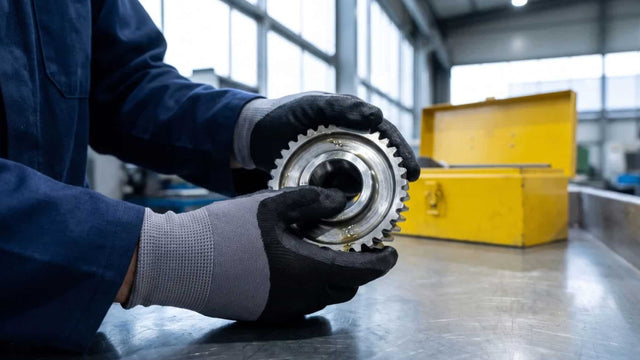
Puncture resistant gloves are rated on a different test from cut resistant gloves. Under ANSI/ISEA 105-2024, a sliding blade sets the cut level, a sharp probe sets the puncture level, and a separate needle test covers hypodermic needles. CACO America recommends naming every rating a task needs, since a high cut score tells you little about points.
I have worked in PPE for more than 30 years, since I joined our family business in 1992. Caco Abbo Group holds the exclusive General Electric (GE) PPE license across the Americas and the Caribbean, and we supply distributors in more than 38 countries. The spec sheets that cross my desk still mix these hazards up. This guide separates them, test by test, and shows how to write a glove spec that covers each one. For the full cut scale, see our ANSI cut level decoder.
Three hazards, three separate tests
ANSI/ISEA 105-2024 lists mechanical protection as four classifications: cut, puncture, hypodermic needle puncture, and abrasion. Each has its own method and its own scale.
Cut: the sliding blade
Cut resistance is measured on a TDM machine under ASTM F2992-23. A straight blade travels across the palm material, and the score is the grams of force needed to cut through in 20 mm of travel. The scale runs A1 (200 grams) to A9 (6,000 grams).
Puncture: the probe
Puncture resistance is assessed by the force needed to push a sharp probe through the material, per ISEA. Results land on Levels 0 to 5, measured in newtons.
Hypodermic needle: the finest point
Needles get their own classification. The test method, ASTM F2878, measures the force a sharp-edged hypodermic needle needs to penetrate the material. The method allows three needle sizes, from 21 to 28 gauge. A probe and a needle behave very differently against a knit, which is why ISEA warns that not every puncture-resistant glove stops needle sticks.
The three ratings side by side
The table pairs each hazard with its test, its scale, and the jobs that need it. Puncture applications come from ISEA's Key to Hand Classifications.
| Hazard | Test Method | ANSI/ISEA 105-2024 Scale | Typical Jobs | What to Check on the Spec |
|---|---|---|---|---|
| Slicing Edge | TDM blade test, ASTM F2992-23 | Cut A1 to A9 (200 to 6,000 grams) | Sheet metal, glass edges, box cutting, metal fabrication | The A-level at the top of the pentagon |
| Puncture Probe | Sharp probe pushed through the material | Puncture Levels 0 to 5 (Level 1 starts at 10 N, Level 2 at 20 N, Level 3 at 60 N, Level 4 at 100 N) | Construction, metal stamping, glass handling, recycling, oil and gas, demolition | The puncture digit on the right of the pentagon |
| Hypodermic Needle | ASTM F2878 needle test | Separate needle puncture classification | Waste and recycling sorting, sanitation, search work | A needle rating stated on the spec sheet or test report |

Reading the label: the pentagon and the EN 388 code
The 2024 edition added a pentagon pictogram. ISEA's labeling guidelines place the cut rating at the top, abrasion on the left, and puncture on the right. The badge carries those ratings only. A needle classification has to appear elsewhere, so look for it on the spec sheet.
Most gloves sold across borders also carry the European EN 388 code. On our product pages, the fourth digit of that code is the puncture score, and the trailing letter is the ISO cut result. Our GG201, for example, shows 4X42F with a puncture score of 2 at 60 N.
Treat the two systems as separate scales. Compare the newton figure, and ask which test produced it before you call two gloves equal.

Which jobs need both cut and puncture protection
Plenty of tasks bring edges and points together. ISEA's key lists overlapping applications on both scales, and the overlap is where spec mistakes cost the most.
- Construction and demolition.Sheet edges and loose nails often share one shift. ISEA places heavy construction and demolition at puncture Level 5.
- Metal stamping and glass handling.Both appear on ISEA's lists for higher cut levels and for puncture Levels 3 and 4.
- Recycling and sorting.ISEA lists recycling at puncture Level 4, and sorting lines handle broken glass and torn metal.
- Oil and gas, plus mining.ISEA's chart puts both at puncture Level 5, and rig work often needs impact protection on top.
Wet sites add a grip problem. Our sibling guide on glove coatings compares how each palm finish holds on oily or wet parts, which matters as much as any rating once the surface turns slick.
Needlestick exposure: waste, recycling, sanitation, and searches
Needles show up where nobody planned for them: trash bags, recycling streams, park cleanups, and pockets during searches. A stick can expose a worker to hepatitis B, hepatitis C, or HIV, according to NIOSH.
OSHA's bloodborne pathogens standard defines contaminated sharps as any contaminated object that can penetrate the skin, needles and broken glass included. NIOSH ranks gloves below engineering controls and safe work practices. Puncture-resistant sharps containers and a no-reaching rule do more than any glove.
For the residual risk, specify a glove with a stated ANSI/ISEA 105 hypodermic needle classification. None of the three CACO gloves in this guide lists one, and our current catalog does not list a needle-rated glove. They earn their place on edges and probe points.
"If a crew reaches blind into bags, the only number I care about is the needle rating on a test report. The cut level on the tag says nothing about that hand." Joel Abbo, CEO, Caco Abbo Group
Where GG201, GG421, and GG422 fit
All three gloves sit in our cut resistant gloves collection, and each states its puncture score on its live page.
The GG201 A6 Cut Resistant Safety Gloves pair ANSI A6 with an EN 388 puncture score of 2 (60 N). A 13 gauge liner of HPPE, steel wire, basalt, spandex, and polyester sits under a gray PU palm that works best on dry parts. Sizes run M to XL in 12 packs or hanging cards.
The GG421 A7 Cut & Impact Resistant Driver Gloves carry the strongest puncture result of the three, an EN 388 score of 4 at 150 N. They add ANSI A7 cut and ANSI/ISEA 138 Level 2 impact protection in water and oil repellent goatskin with a cowhide palm.
The GG422 Hi-Vis TPR Impact Resistant Cut A4 Work Gloves combine ANSI A4, ANSI/ISEA 138 Level 2 impact, and EN 388 puncture 2 in hi-vis synthetic leather. They ship in 1, 3, 5, or 10 packs. More back-of-hand options sit in our impact resistant gloves range.

How to specify cut and puncture resistant gloves
A good spec names the hazard first and the glove second. OSHA's hand protection rule requires employers to select gloves based on the task, conditions, duration of use, and hazards identified, and our PPE hazard assessment guide walks through that step.
- List every sharp object.Match each one to its rating using the table above.
- Ask for each rating in writing.An X on the pentagon means the property was not tested or does not apply, so ask for the test report before the order goes in.
- Check where the protection sits.ANSI/ISEA 105-2024 lets manufacturers report different classifications for different areas of the glove.
- Match the environment.Oily pipe work favors water and oil repellent leather such as the GG421. Dry parts suit a PU palm like the GG201.
- Trial before you buy in volume.First-time buyers can start with hanging cards or small packs, while seasoned buyers ordering case quantity should still run a two-week trial on one crew.
Fit and replacement matter too. Retire any glove with a damaged palm, since it no longer performs at its tested score, and choose a size that fits close at the fingertips. For task-by-task cut picks, see our roundup of the best cut resistant gloves by task.
Build a glove spec that covers points as well as edges
Walk the task, name the sharpest object, and match a rating to each hazard. When edges and probe points share the job, compare A-levels and puncture scores side by side in our cut resistant gloves range, then ask our team for wholesale pricing on the SKUs that fit your crews.
Frequently asked questions
Are cut resistant gloves also puncture resistant?
Only if the glove carries a puncture rating of its own. ANSI/ISEA 105-2024 scores cut and puncture with separate tests, so a high A-level says nothing certain about points. Our A6 GG201 and A4 GG422 show the same EN 388 puncture score of 2. Read the puncture digit on the right side of the ANSI pentagon, or the fourth digit of the EN 388 code.
What are needle resistant gloves?
Needle resistant gloves carry an ANSI/ISEA 105 hypodermic needle puncture classification, tested under ASTM F2878 with a 21, 25, or 28 gauge needle. That rating is separate from the probe puncture level and does not appear inside the ANSI pentagon. ISEA notes that not every puncture-resistant glove protects against needle sticks, so ask for the needle result on the spec sheet.
What puncture level do I need for construction?
ISEA's Key to Hand Classifications lists light construction at puncture Levels 1 and 2, general construction at Levels 3 and 4, and heavy construction and demolition at Level 5. Level 3 starts at 60 newtons and Level 4 at 100 newtons. Pair the puncture level with a cut level for sheet edges, and add ANSI/ISEA 138 impact protection where hands take hits.
Can any glove be fully puncture proof?
No glove makes a hand immune to a point. Every rating measures resistance in a controlled lab test, so a higher level buys more margin against the force tested. Real points vary in sharpness, angle, and speed. That is why NIOSH guidance puts engineering controls and safe work practices, such as sharps containers and a no-reaching rule, ahead of gloves.
How do I read the EN 388 code for puncture?
The EN 388 code lists mechanical results in a fixed order. On our product pages, the first digit is abrasion, the second is coup cut, the third is tear, the fourth is puncture, and the letter is the ISO 13997 cut result. The GG421 code, 4544F, shows a puncture score of 4 at 150 newtons. An X means that property was not tested.
Does OSHA require puncture resistant gloves?
OSHA does not name a specific rating. Under 29 CFR 1910.138, employers must provide appropriate hand protection when hands face hazards including punctures and severe cuts, and must base the choice on the task, conditions, duration of use, and hazards present. ANSI/ISEA 105-2024 is voluntary, but its ratings give employers a clear way to document that choice.
Which CACO gloves have the highest puncture score?
Among our cut resistant gloves featured here, the GG421 A7 Cut & Impact Resistant Driver Gloves carry the highest stated puncture result, an EN 388 score of 4 at 150 newtons. The GG201 and GG422 each show a puncture score of 2. None of these pages lists an ANSI/ISEA 105 needle classification, so use a needle-rated glove where hypodermic needles are a hazard.