Hard hats and safety helmets both certify to ANSI/ISEA Z89.1, but they solve different problems. A traditional hard hat protects the top of the head. A modern safety helmet adds a chin strap, lateral impact protection, and a fit that stays put during a slip or fall. Retire either one immediately after any impact.
That is the short version. The long version is the buying guide below, and it is the conversation we have at CACO America every week, because head protection is changing faster than any other PPE category we carry. I have worked in this industry for more than 30 years since joining our family company in 1992, and I have never seen a product transition move this quickly.
Why the jobsite is switching
The numbers explain the urgency. The International Safety Equipment Association reports 195,720 head injuries to US workers from 2021 to 2022, and 684 workers died from their injuries in 2022, per the ISEA head protection facts page. ISEA also cites research finding that fewer than half of workers who suffered a fall-related head injury were wearing any head protection at all.
OSHA responded with a dedicated bulletin, Head Protection: Safety Helmets in the Workplace, SHIB 3-6-2024. It walks through the case for climbing-style safety helmets on modern jobsites, and OSHA did not stop at advice. After a Job Hazard Analysis of its own field work, the agency issued Type II, Class G safety helmets to its own employees. When the regulator picks a helmet for its own inspectors, distributors should pay attention to the spec.
Neither document bans the classic construction helmet. Z89.1-compliant hard hats remain fully legal. The shift is being driven by hazard data, not by rule changes.
What actually changed between the two designs
Put the two products side by side and the differences are physical, not cosmetic.
- Chin straps.OSHA's bulletin recognizes chin straps as an effective way to keep head protection on during work in awkward positions, slips, and falls, and states they should be considered for use with all head protection. A brim-first tumble from a ladder usually knocks a strapless hard hat off before the head hits anything.
- Side impact protection.Most legacy hard hats are Type I, rated for top-of-head blows only. Safety helmets are commonly built to Type II, which adds lateral coverage.
- Energy management.Some modern designs add materials that distribute impact energy through the shell and reduce rotational forces, an approach OSHA's bulletin describes as advanced energy re-distribution.
- Vents and comfort.Vented shells move air on hot roofs and decks. The trade-off matters, and we cover it in the Class table below.
- Impact indicators.Mountable indicator technology can flag a hit for concussion awareness.
Every one of those features answers a documented failure mode of the older design. That is why the transition guide framing fits: this is less a product refresh than a correction.
Decoding ANSI/ISEA Z89.1: Types and Classes
Every compliant helmet, old style or new, carries two markings under ANSI/ISEA Z89.1. Learn to read them and the whole catalog opens up.
Type covers impact geometry. Type I protects against blows to the top of the head. Type II protects against blows to the top and sides.
Class covers electrical exposure, and OSHA's SHIB gives the verified proof-test numbers. Class G (General) is proof tested at 2,200 volts phase to ground. Class E (Electrical) is proof tested at 20,000 volts phase to ground. Class C (Conductive) provides no electrical protection at all. One hard rule from the same bulletin: vented hard hats or safety helmets cannot be used for electrical work. Airflow holes and dielectric protection do not coexist.

| Helmet Marking | Impact Protection | Electrical Rating | Best Application |
|---|---|---|---|
| Type I, Class G | Top-of-head impact protection | Proof tested at 2,200 V | General construction, maintenance, and trade work with incidental low-voltage exposure. |
| Type I, Class E | Top-of-head impact protection | Proof tested at 20,000 V | Electrical, utility, and power distribution work. Use only non-vented helmets. |
| Type I, Class C | Top-of-head impact protection | No electrical protection | Hot environments and general work where there is no electrical hazard. Vented helmets are acceptable. |
| Type II, Class G | Top and side impact protection | Proof tested at 2,200 V | Construction and industrial jobs requiring side-impact protection. OSHA uses this type for its field staff. |
| Type II, Class E | Top and side impact protection | Proof tested at 20,000 V | Electrical line work, substations, and elevated utility work where both electrical and impact hazards exist. |
| Type II, Class C | Top and side impact protection | No electrical protection | Working at height, communication towers, wind turbines, and steep-slope roofing. Vented helmets are suitable. |
Voltage figures per OSHA SHIB 3-6-2024.
Suspension systems and the fit rule
The suspension is the half of the product buyers never look at, and it does most of the work. That internal cradle of straps and headband keeps a gap between skull and shell so impact energy spreads before it reaches the head. Most quality helmets pair it with a ratchet adjustment wheel at the rear so workers dial in tension with one hand, gloves on.
Fit is now a compliance issue, not a comfort preference. OSHA's construction PPE standard at 29 CFR 1926.95(c) requires that PPE be of safe design and construction and be selected to ensure that it properly fits each affected employee. OSHA's helmet bulletin says the same thing in plainer language: adjust the suspension to a snug fit without excessive pressure points, never too loose or too tight.
For distributors, fit is also the cheapest upsell in the category. Spare suspensions, sweatbands, and sized options keep a crew compliant between shell replacements.

Accessories: build the helmet into a platform
A modern helmet is a mounting platform, and accessory revenue often outruns the shell itself. The common attachments:
- Face shields and visorsfor cutting, grinding, and splash exposure, working alongside dedicated protective eyewear
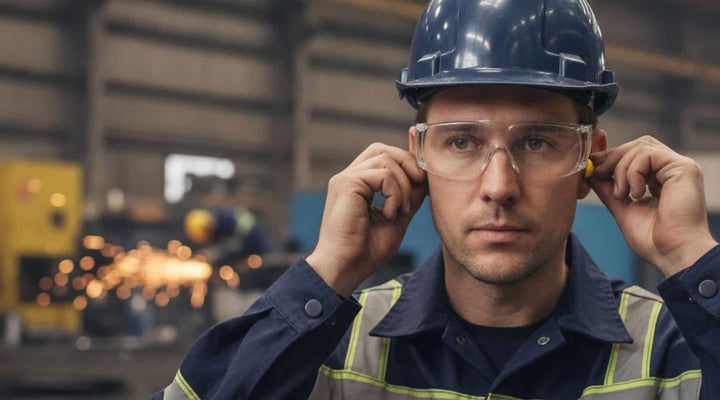
- Earmuff mounts.Cap-mounted earmuffs clip into side accessory slots, so crews stop losing standalone hearing protection between shifts.
- Lamp brackets and clipsfor headlamps on night pours, tunnels, and confined spaces.
One caution from OSHA's bulletin: use manufacturer-approved accessories and inspect the attachment points along with the shell. A shield that fits the accessory slot of one helmet series may not be certified on another. We covered where integrated helmet systems are heading in our piece on innovations in safety equipment.
When to replace a hard hat or safety helmet
This is the question I get most, so here is the honest answer: there is no universal federal expiration date. OSHA's bulletin says to refer to the manufacturer's guidelines for recommended lifespan, because service life depends on storage, handling, use, and exposure to harsh environments including UV rays.
Manufacturers publish real numbers, though. MSA, one of the largest head protection makers, recommends that its hard hat shells be used no longer than five years and suspensions be replaced after 12 months, both counted from the date of first use. Follow the interval printed by whichever manufacturer made the helmet on your shelf.
Three rules hold everywhere, straight from OSHA's inspection guidance:
- Any impact retires the helmet immediately, even with no visible damage.Head protection is designed for single-use impact protection.
- UV degradation is real.Chalky, faded, or brittle shells come out of service. Never store helmets on a rear dashboard or anywhere with direct sunlight and temperature extremes.
- Inspect before use and keep records.Check the shell for cracks and dents, the suspension for wear, and the labels for legibility. Log the purchase date and inspections.

The GE safety helmet line we carry
CACO America holds the license for GE-branded PPE across the Americas and the Caribbean, and the GE safety helmet line is where the transition gets practical. Every model in the series is built around Koroyd, a welded-tube core originally proven in cycling and ski helmets that crumples on impact to absorb energy, and the line is engineered for airflow that keeps vented models measurably cooler under summer sun.
The lineup maps cleanly onto the decoder matrix above. The GH400 is a vented Type 1 helmet rated Class C. The GH401 is its non-vented, dielectric Class E twin. The GH500 brings vented Type 2 coverage at Class C for work at height, and the GH501 tops the range as a non-vented Type 2 certified Class E and G. Chin straps and ratchet suspensions run across the series, with visors, brims, and mount accessories that fit the same shells. Our guide to choosing the right safety helmet walks the selection step by step.
For distributors: stock the upgrade wave
Here is the market read I give our partners. The installed base of legacy hard hats in North America is enormous, replacement cycles are short, and OSHA has now modeled the upgrade by putting Type II safety helmets on its own staff. Every one of those replacement moments is a chance to move an account up the value curve, from a commodity shell to a helmet system with straps, mounts, and recurring accessory sales.
Practical stocking guidance:
- Carry both. Hard hats stay compliant and hold the price-sensitive line. Safety helmets win the spec-driven bids.
- Stock the full head protectionmatrix: at minimum one vented Class C and one non-vented Class E option in both Type 1 and Type 2.
- Hold suspensions and chin straps as consumables. Twelve-month suspension guidance from manufacturers like MSA turns every shell you have ever sold into a repeat order.
- Sell the replacement audit. Walk an account's gang boxes, date-check shells, and quote the swap-outs. Our distributor guide to navigating the safety gear marketcovers the standards conversation that closes those deals.
We support distributor partners in more than 38 countries, we hold the GE PPE license that includes this helmet line, and we secured the first license for WD-40 branded microfiber towels. Head protection sits at the center of all of it, which is why safety helmets made our list of the five most in-demand safety products for 2026.
"A hard hat sale is a transaction. A helmet program, with fit checks, dated shells, and accessory slots filled, is a relationship. Distributors who learn to read a Z89.1 label will own this category for the next decade." - Joel Abbo, CEO, Caco Abbo Group
FAQ
1. Are hard hats still OSHA compliant, or do I need a safety helmet?
Traditional hard hats remain fully compliant. OSHA's head protection standards, 29 CFR 1910.135 for general industry and 1926.100 for construction, accept head protection meeting ANSI Z89.1, and both hard hats and safety helmets certify to it. OSHA's 2024 bulletin recommends considering safety helmets for specific hazards, and the agency chose them for its own staff, but no rule requires the switch.
2. What is the difference between Type I and Type II head protection?
Type I head protection is rated for blows to the top of the head, which covers the classic falling-object scenario. Type II adds protection against blows to the top and sides of the head. OSHA suggests considering Type II with chin straps for construction sites with struck-by risks, awkward working positions, or slip, trip, and fall hazards.
3. What do Class G, Class E, and Class C mean on a hard hat?
The Class marking covers electrical exposure. Class G, General, is proof tested at 2,200 volts phase to ground. Class E, Electrical, is proof tested at 20,000 volts. Class C, Conductive, carries no electrical rating at all. Match the Class to the site's electrical hazard assessment, and remember that vented helmets are never acceptable for electrical work.
4. How often should hard hats be replaced?
Follow the manufacturer's stated service life, which OSHA's guidance defers to. As one verified example, MSA recommends its shells be used no longer than five years and suspensions be replaced after 12 months, from first use. Sun, heat, chemicals, and rough handling shorten those windows. Any helmet that takes an impact retires immediately regardless of age.
5. Do hard hats expire?
Not in the sense of a regulated expiration date. Shells carry a molded date of manufacture, and manufacturers publish recommended service lives counted from first use. UV exposure, temperature extremes, and chemical contact degrade the plastic over time, so a helmet stored on a truck dashboard ages far faster than one kept in a locker. Inspect before every use and record purchase dates.
6. Why do modern safety helmets have chin straps?
Because a helmet only works while it is on the head. OSHA's bulletin recognizes chin straps as an effective way to keep head protection in place during work in awkward positions, slips, and falls, and says they should be considered for all head protection. For work at height, a strap also keeps the helmet from becoming a dropped object.
7. Can I put stickers or aftermarket accessories on a safety helmet?
Stick to manufacturer-approved accessories mounted in the designed slots, then inspect those attachment points as part of the regular routine. OSHA's inspection guidance calls for checking that accessories are undamaged, securely fastened, and functioning. Unapproved drilling, adhesives, or paints can compromise the shell or void the certification on the label.
Ready to stock the head protection shift?
Talk to CACO America about distributor pricing on the GE safety helmet line, legacy hard hat inventory, and the accessory program that turns one shell sale into years of reorders. Browse the full catalog or contact our team, and we will help you build a head protection matrix that fits the accounts you serve.