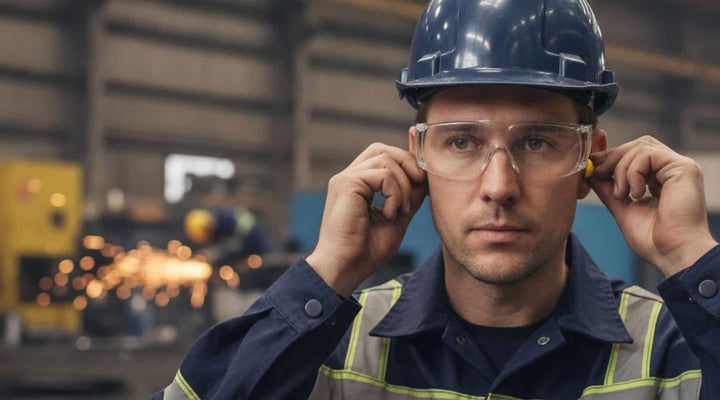
Choose safety glasses for impact hazards like flying particles, chips, and debris. Choose safety goggles when the eye needs a sealed fit against chemical splash, dust, or heavy grinding. Add a face shield over either one for the worst jobs, never on its own. The lens marking settles the choice: Z87+ covers impact, D3 covers splash, D4 and D5 cover dust.
At CACO America we have shipped protective eyewear and other PPE to buyers across 38 plus countries, and this guide condenses what three decades in the trade taught us about picking the right pair.
Glasses, Goggles, or Face Shield: Match the Protector to the Hazard
The stakes are not abstract. NIOSH reports that about 2,000 U.S. workers sustain a job-related eye injury requiring medical treatment every day. Roughly one third of those injuries are treated in hospital emergency departments, and more than 100 per day cost at least one day away from work. The American Optometric Association adds the hopeful half of the statistic: experts believe the right eye protection can lessen the severity of, or even prevent, 90 percent of these injuries.

So the real question is not whether to protect, it is which format fits the hazard. Safety glasses breathe and stay comfortable all shift, but they leave gaps at the brow and cheek. Goggles close those gaps with a full seal. Face shields protect the face, yet AOA guidance is blunt that they should never be the only layer, so pair them with glasses or goggles underneath.

| Protection Type | Best For | Key Marking to Look For |
|---|---|---|
| Safety Glasses with Side Shields | Flying particles, wood chips, sawdust, and general impact work. | Z87+ (Impact Rated) |
| Indirect-Vent Safety Goggles | Chemical splashes, liquid droplets, pouring, and mixing chemicals. | Z87+ with D3 |
| Direct or Indirect-Vent Goggles | Heavy dust, fine airborne particles, and grinding debris. | Z87+ with D4 or D5 |
| Face Shield over Glasses or Goggles | Grinding, molten metal, heavy chipping, and severe chemical splash. | Z87+ (Worn as a secondary layer) |
How to Read ANSI/ISEA Z87.1 Markings
Every legitimate claim about industrial eyewear traces back to one document: ANSI/ISEA Z87.1, the American National Standard for eye and face protection, now in its 2025 edition. The markings stamped on the temple or lens are the standard's shorthand, and they read like this:
| ANSI Marking | What It Certifies |
|---|---|
| Z87 | Meets all applicable ANSI Z87.1 requirements for basic eye protection. |
| Z87+ | Impact-rated; passed both high-mass and high-velocity impact tests. |
| Z87-2 / Z87-2+ | Prescription (Rx) protector or impact-rated prescription protector. |
| D3 | Tested and certified for splash and droplet protection. |
| D4 | Tested and certified for dust protection. |
| D5 | Tested and certified for fine dust protection. |
| U + Scale Number | UV filter lens; the accompanying scale number indicates the level of ultraviolet filtration. |
| W Shade, R, L | Indicates welding filter shade, infrared (IR) filter, or visible light filter. |
| X | Anti-fog lens designation introduced with testing requirements in the ANSI Z87.1-2020 standard. |
| H | Eyewear is sized to fit smaller head sizes. |
The plus sign is earned, not printed. In the high-velocity test a quarter-inch steel ball is fired at spectacles at 102 mph and at goggles at 170 mph, and in the high-mass test a 500-gram pointed projectile drops about 50 inches onto the lens on a headform. Nothing may crack, detach, or touch the eye area. When a distributor customer asks me why two visually identical frames are priced apart, the answer usually starts at that marking.

Prescription Safety Glasses: What Buyers Should Know
Prescription safety eyewear is its own category under the standard, marked Z87-2, and OSHA addresses it directly: workers who wear corrective lenses must use eye protection that either incorporates the prescription or sits over the glasses without disturbing either lens. Buyers have three honest routes.
- Prescription-ready safety frames.An optical lab grinds your Rx into Z87-2 rated frames. Best optics, highest cost, and each worker needs an individual order.
- Rx inserts.A small prescription carrier clips inside a goggle or sealed frame. One outer protector, swappable inner lens.
- Over-the-glasses (OTG) styles.Oversized protectors engineered to fit over everyday eyewear. No lab, no lead time, one SKU covers a whole crew.
Full disclosure: CACO America does not sell prescription lenses. For crews that need coverage today, OTG is the workhorse answer, and our GE PPE 12 Series OTG safety glasses and OTG-fit goggles exist precisely for that gap. For dedicated Rx programs, work with an optical lab and verify the Z87-2 stamp on delivery.
Lens Materials and Coatings That Earn Their Cost
Nearly every serious safety lens today is polycarbonate, and the AOA notes that polycarbonate provides the highest level of impact protection among safety lens materials. It is also light, which matters more at hour nine than at minute one. From there, coatings decide whether the eyewear stays on the face.
- Anti-fog.The number one reason workers pull eyewear off is a fogged lens. Since the 2020 edition, Z87.1 includes a tested X marking for anti-fog performance, so the claim is verifiable rather than a sticker.
- Anti-scratch.Hard coatings extend lens life and keep optical clarity acceptable, which is what keeps compliance honest week after week.
- UV protection.Look for the U scale marking on lenses for outdoor crews.
- Smoke and mirror lenses for glare, amber for low light, clear for indoor work.
Across our GE PPE line, which we hold under an exclusive license for the Americas and the Caribbean, anti-fog is the default coating on most SKUs for exactly this reason.
What OSHA 1910.133 Actually Requires
The federal rule behind every eyewash-station poster is 29 CFR 1910.133. It is short, and four requirements do the work:
- Employers must ensure workers use appropriate eye or face protection when exposed to flying particles, molten metal, liquid chemicals, acids or caustics, chemical gases or vapors, or injurious light radiation.
- Where flying objects are the hazard, the protection must include side protection. Detachable side shields that meet the requirements are acceptable.
- Prescription wearers must get protection that incorporates their Rx or fits over it properly.
- Every protector must be distinctly marked to identify its manufacturer.
The regulation incorporates the 2010, 2003, and 1989 (R-1998) editions of Z87.1 by reference, and it also accepts protection demonstrated to be at least as effective. In practice, buying current-edition Z87.1 eyewear from a documented supplier keeps a safety manager on the right side of all four lines. We covered the wider compliance picture in our guide to navigating the safety gear market.
"An eye injury is the cheapest injury to prevent and one of the most expensive to explain. The marking on the temple is a two-second read that settles the argument before it starts."
For Distributors: Stocking an Eye Protection Wall That Sells
I joined our family business in 1992, and eyewear taught me an early lesson: it sells like apparel and performs like PPE, so you have to stock it as both. Here is the mix that moves for the distributors we supply.
- Cover every frame style.Frameless and half-frame for all-day comfort, full-frame for durability, wrap-around for coverage. Crews reject eyewear on fit before they ever read a rating.
- Carry OTG in depth.Prescription wearers exist on every crew, and the distributor with OTG stock on the shelf wins the order the day the safety audit lands.
- Make anti-fog the default.Fogged lenses end up on foreheads, and eyewear on a forehead protects nothing.
- Add sealed goggles and spoggles.Indirect-vent safety goggles for splash work, spoggle hybrids for crews that want glasses comfort with goggle sealing.
- Bundle at the counter.Eyewear attaches naturally to hand protection and the other categories in our roundup of the most in-demand safety products for 2026.
Margins stay healthy because unit costs are low, reorders are steady, and lens options multiply the reasons a customer comes back. Smart eyewear will eventually join the wall too, a shift we tracked in our piece on innovations in safety equipment.
FAQ
1. Are Z87 safety glasses OSHA compliant?
Generally yes, when they match the hazard. OSHA 1910.133 requires protection that complies with a referenced edition of ANSI Z87.1 or is at least as effective, and current-edition Z87 eyewear meets that bar in practice. Compliance still depends on selection: impact work needs the Z87+ mark and side protection, and splash work needs a sealed D3 goggle, not spectacles.
2. What is the difference between Z87 and Z87+?
Z87 means the protector meets the standard's basic requirements. Z87+ means it also passed the high-mass and high-velocity impact tests, in which a quarter-inch steel ball strikes spectacles at 102 mph and goggles at 170 mph without the lens cracking or detaching. For grinding, cutting, chipping, and most industrial work, specify Z87+.
3. Can workers wear safety glasses over prescription glasses?
Only if the protector is designed for it. OTG (over-the-glasses) safety glasses and OTG-fit goggles are sized and vented to sit over everyday frames without disturbing either lens, which is exactly what OSHA 1910.133 requires for prescription wearers. Forcing standard safety glasses over Rx frames breaks the fit of both and leaves impact gaps.
4. When are goggles required instead of safety glasses?
Whenever the hazard can reach the eye around an open frame. Chemical splash, pressurized liquids, heavy airborne dust, and fine particulates all call for a sealed goggle carrying the D3, D4, or D5 marking. Safety glasses, even with side shields, only interrupt straight-line impact paths, so they cannot protect against liquids or dust clouds.
5. What do D3, D4, and D5 mean on goggles?
They are use ratings from ANSI/ISEA Z87.1. D3 certifies the protector was tested for splash and droplet protection, D4 for dust, and D5 for fine dust. A goggle marked Z87+ D3 D4 D5 is impact rated and sealed against liquids and particulates, which makes it the safe default for mixed chemical and dusty environments.
6. Do safety glasses block UV light?
Only if they carry a UV filter, marked U with a scale number under Z87.1. Clear lenses without the marking make no certified UV claim, so outdoor crews should specify the U rating and consider tinted options for glare. Verify the stamp on the lens rather than trusting product photos or listing copy.
7. What is a spoggle?
A spoggle is a hybrid between safety glasses and goggles: a spectacle-style frame with a foam or rubber gasket that seals against the face, often with a convertible strap. Crews choose them when full goggles feel heavy but open glasses let in too much dust. They carry the same Z87.1 markings as any other protector.
Get the Eyewear Wall Working for You
Every SKU in our protective eyewear catalog is ANSI Z87.1 rated, coated for real shifts, and priced for resale margin, from frameless glasses to indirect-vent goggles. If you resell PPE, apply to become a CACO America distributor for regional pricing and program support, or call our Medley, FL team for a bulk quote.